Comprehensive Management Strategies for Disseminated Intravascular Coagulation (DIC)
Learn effective methods for managing severe DIC, including control of hemodynamic parameters, respiratory support, surgery, replacement therapy, and more. Discover how to address hemorrhagic symptoms and low levels of coagulation factors to improve patient outcomes.

Comprehensive Management Strategies for Disseminated Intravascular Coagulation (DIC)
E N D
Presentation Transcript
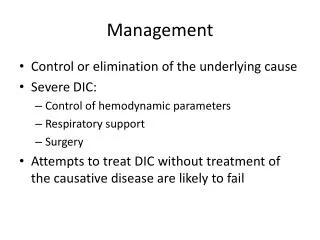
Management • Control or elimination of the underlying cause • Severe DIC: • Control of hemodynamic parameters • Respiratory support • Surgery • Attempts to treat DIC without treatment of the causative disease are likely to fail
Management of hemorrhagic symptoms • DIC with marked thrombocytopenia and low levels of coagulation factors: • Replacement therapy • FFP • Low levels of fibrinogen or brisk fibrinolysis: • Cryoprecipitate • The replacement of 10 U of cryoprecipitate for every 2-3 U of FFP is sufficient to correct the hemostasis • Platelet concentrates at a dose of 1-2 U/10 kg body weight are sufficient for most DIC patients with severe thrombocytopenia
Management • Clotting factor concentrates are not recommended for control of bleeding in DIC because of the limited efficacy afforded by the replacement of single factors
Replacement of coagulation or fibrinolysis inhibitors • Low doses of continuous infusion heparin (5-10 U/kg/h) may be effective in patients with low-grade DIC associated with solid tumor or APL or in a setting with recognized thrombosis • Antifibrinolytic drugs, EACA, Traxenamic acid • Prevent fibrin degradation by plasmin • But can increase risk for thrombosis (concomitant use of heparin is indicated) • For patients with APL, chronic DIC associated with hemangiomas • Protein C concentrates