Motion in Two and Three Dimensions: Position & Displacement
270 likes | 340 Vues
Learn about position vector, displacement, and velocity in both 2D and 3D motion, with examples and unit vector notation. Explore average and instantaneous velocity and acceleration concepts.


Motion in Two and Three Dimensions: Position & Displacement
E N D
Presentation Transcript
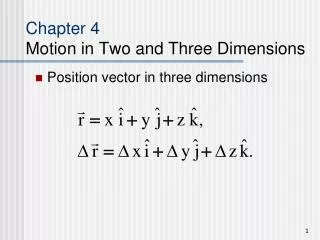
4-2 Position and Displacement The position vector is typically used to indicate the location of a particle. The position vector is a vector that extends from a reference point (usually the origin) to the particle.
The position vector for a particle is the vector sum of its vector components.
The coefficients x, y, and z give the particle’s location along the coordinate axes and relative to the origin.
As a particle moves, its position vector changes in such a way that the position vector always extends to the particle from the reference point (origin).
If the position vector changes from during a certain time interval, then the particle’s displacement during that time interval is:
Sample Problem 4-1 In figure 4-2 the position vector for a particle is initially and then later it is
Sample Problem 4-2 A rabbit runs across a parking lot on which a set of coordinate axes has been drawn. The coordinates of the rabbit’s position as functions of time t are given by: x = -0.3t2 + 7.2t + 28 y = 0.22t2 - 9.1t + 30
At t = 15 seconds, what is the rabbit’s position vector in unit-vector notation and as a magnitude and an angle?
Average Velocity and Instantaneous Velocity If a particle moves through a displacement in time interval D t, then its average velocity is:
The instantaneous velocity is the value that approaches in the limit as Dt shrinks to 0.
The direction of the instantaneous velocity of a particle is always tangent to the particle’s path at the particle’s position.
The velocity of a particle along with the scalar components of
Sample Problem 4-3 For the rabbit in sample problem 4-2, find the velocity at time t = 15 s, in unit vector notation and as a magnitude and an angle.
Average Acceleration and Instantaneous Acceleration When a particle’s velocity changes from to in a time interval Dt, its average acceleration a avg during Dt is: