Leg Ergometer for Blood Flow Studies
200 likes | 331 Vues
This project presents the design and development of a leg ergometer specifically tailored for blood flow studies. The device enables test subjects to perform a constant kicking motion while allowing a passive return to the initial leg position. Employing ultrasound imaging of the femoral artery, it facilitates the measurement of blood flow during exercise. The project outlines the problem statement, background of blood flow research, design requirements, alternatives, and proposed future work. The ergonomic and efficient design aims to advance our understanding of vascular regulation in conditions such as aging and cardiovascular diseases.


Leg Ergometer for Blood Flow Studies
E N D
Presentation Transcript
Leg Ergometer for Blood Flow Studies Amy Weaver, Cali Roen, Lacey Halfen, Hyungjin Kim BME 201 March 9, 2007
Client: William Schrage Dept. of Kinesiology Advisor: Paul Thompson Dept. of Biological Systems Engineering
Overview • Problem statement • Background • Design requirements • Design alternatives • Proposed Design • Future work
Problem Statement • Test subject will use the ergometer to maintain a constant kicking motion • Leg must passively return to original position • Femoral artery is imaged using an ultrasound • Used to determine blood flow to the leg during exercise
Background: Blood Flow Research • Measure blood flow in femoral artery • Examine how smaller blood vessels regulate upstream (femoral) blood flow • Infuse drugs into the femoral artery
Background Blood Flow Research Two research questions: • What are the neural, metabolic, and vascular signals controlling blood flow at rest and exercise? • How do conditions like aging and cardiovascular diseases (obesity, high blood pressure, etc) alter the regulation of blood flow Wider implications • understanding blood pressure control • correlated with obesity, diabetics, and high blood pressure
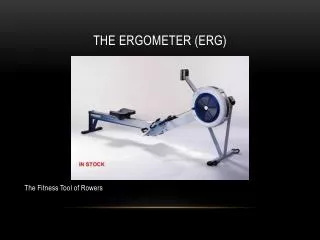
Background: Existing Devices • Current device in use at Mayo Clinic • Used part of an exercise bike and a car seat • Boot is a rollerblade boot with the toe cut out • Device was unreliable, and had variable forces
Background: Existing Devices Cont. http://www.rehab.research.va.gov/jour/01/38/1/chin.html
Design Requirements • Streamlined and compact with minimal loose parts • Minimum lifespan of five years • Easily portable (with wheels) • 5’ long x 3’ wide • Chair positioned at various angles from vertical and 3’ above ground • Adjust for people of heights 5’4” to 6’4” • Flexible range of motion for full leg extension while kicking
Design Requirements • Passive return to rest position of the leg after kicking • Set up for right leg testing • Wattage (0-100 W) and kick rate (30-60 KPM) output to a laptop through an A/D converter • Maintain a constant wattage throughout testing • Adjustable force between tests • Under $2,000
Design Alternatives: • Seat for pateint • Reclining • Adjustable height • “Boot” for foot • Straps to hold shoe • Adjustable force • Wheels for movement • Sensors • Wattage • Kicking rate
Design Alternatives: Gas Spring Shock • Force from compression of gas in a cylinder • Function of velocity • Can be purchased in various sizes with variable force • Use a cable, allowing for full range of kicking motion Disadvantages • Springs back to initial position http://www.globalspec.com/FeaturedProducts/Detail/IndustrialGasSprings/Stainless_Steel_Gas_Springs_/34982/0?fromSpotlight=1
Design Alternatives: One Way Clutch • Allows rotation in only one direction • When clutch locks, friction device is engaged • When foot is returning, clutch freely rotates • Clutch attached to boot by a bar with ball joints http://www.mie.utoronto.ca/staff/projects/cleghorn/Textbook/DataFiles/Appendix-B/Appendix-B.html http://adcats.et.byu.edu/WWW/Publication/94-1/Paper1-12_6.html
Design Alternatives: with Drum Brake • Shoes push out against drum providing friction • Force is constant • Adjustable by altering force normal to drum Disadvantages • Properties change with heat • Brake pedals need to be replaced http://www.howstuffworks.com/drum-brake.htm/printable
Rotating Axle Proposed Design: with Viscous Friction • Viscous friction for force against kick • Two pieces of metal with liquid between • Force = μ*A*v / t • Force altered by changing area • Force remains constant through minor temperature changes http://galileo.phys.virginia.edu/classes/152.mf1i.spring02/Viscosity.htm
Future Work • Finalize design • Order components • Construct design • Test and modify
References • Maximal Perfusion of Skeletal Muscle in Man (Per Andersen and Bengt Saltin) 1984 • Professor Fronczak • ADCATS at Brigham Young University http://adcats.et.byu.edu/WWW/Publication/94-1/Paper1-12_6.html