Download
1 / 16
160 likes | 278 Vues
Continuous Living Cover (CLC) agriculture offers transformative potential but faces significant challenges. Rising grain prices, decreasing coal and CNG prices, and a lack of institutional support hinder progress. However, opportunities exist, such as creating farmer learning networks, improving connections through Global Land-Based Watersheds (GLBW), and enhancing the understanding of CLC's multiple benefits. Strategies for engagement include working closely with landowners, promoting perennial crops, and integrating agroforestry practices. By aligning efforts among stakeholders, we can build sustainable agricultural systems that boost yields and reduce costs.

E N D
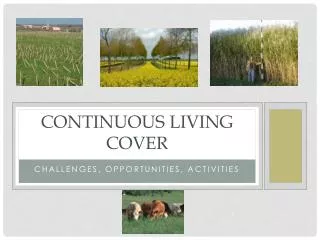
Continuous Living cover Challenges, opportunities, activities
Challenges • High and rising price of grains • Low and dropping price of coal and CNG • Lack of and/or nascent biomass market(s) • Non operational land owners • Logistics, machinery, volume • Value of CLC • Policy: gov’t programs contradictory • Economic return for annual crops • Lack of business interest in developing perennial grain seed
Challenges • Lacks institutional support • Current rules effectively eliminate agroforestry practices from consideration for govt subsidies and cost-share programs • Limited knowledge of CLC among agency personnel • Often relegated to a number of disconnected, disperse and independent practitioners which limits impact at landscape level
Opportunities • Many (at-scale) projects to teach us lessons • CLC the potential to provide multiple benefits • Programs are developing metrics, including sustainability indices • Farmer learning networks • Business opportunities • Value of cover crops
Opportunities • Improve connections to multiple CLC strategies (and watersheds) through GLBW • Incorporating stewardship into land mgmt
Opportunities • Network producers – roving herds to graze cornstalks, rehabilitate land, manage public grazing lands, remove invasive species • Demonstrate opportunities for young farmers • Research and reach out to non-operating landowners • Perennial forage in rotation boosts annual crop yields and reduces input costs
What worked • They read about CC in a magazine & wanted to try it. *Lesson: Get this info into farm magazines. Tie it to healthy soil • Working with non-operating landowners; widowed landowners • Need dedicated staff time – face to face very important • Identify an opinion leader in the community; or a network of those; and work with them.
What worked • Build relationship with respected crop consulting firms • Landowners respond to seeing how their property fits into the larger landscape (maps). • Targeted placement of CLC on the landscape • Payments for practices • Coop friendly management assistance
What is missing • Engaging BANKERS
What does not work • Large outreach meetings where you get everyone together. They have an important role to play, but you need face-to-face follow-up with people. • Just throwing incentive $$$ at people isn’t enough • Inconsistent rules for programs
What should work • Working with CCAs is a potent idea. CCAs starting to recognize importance of soil biology, soil health. There’s some interest to build on. • Seed company meetings pull in lots more people than Extension. For cover crops, this is potentially a strategy; to get the seed companies to talk about it • Track our progress • Get NASS to track CLC
What should work • Better communication about CLC • Branding, consistent language • Tie message to production, different than land retirement • Provide a menu of solutions • Manage for production and environmental quality
What should work • Promote a new model for CRP reform that allows for working lands • Develop local markets at scale to support production • Develop payments for ecological services • We have local examples being implemented • Partner with corporate environment programs • Targeted easements requiring perennial vegetation
What should work • Economic analysis of CLC land-use to help with implementation • Focus on job creation/economic development first land-use change will follow • Involving all stakeholders (agronomist, crop consultants, land owners, etc) • Producer champions • Get farmer leaders to talk with other farmers – peer to peer learning • Market development for CLC systems