Possessive adjs
This guide explores French possessive adjectives, focusing on their forms and usage for different genders and numbers. Learn the rules for "mon," "ma," "mes" (my), "ton," "ta," "tes" (your), "son," "sa," "ses" (his/her/its), and "leur," "leurs" (theirs). Key points include agreement with the noun being owned, regardless of the owner's gender. Through examples and practice exercises, you will gain a solid understanding of how to properly use these possessive forms in everyday French conversation.

Possessive adjs
E N D
Presentation Transcript
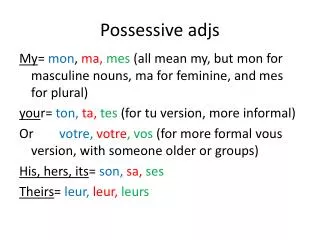
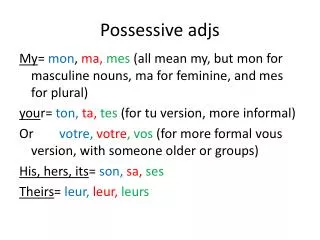
Possessive adjs My= mon, ma, mes(all mean my, but mon for masculine nouns, ma for feminine, and mes for plural) your= ton, ta, tes(for tu version, more informal) Or votre, votre, vos(for more formal vous version, with someone older or groups) His, hers, its= son, sa, ses Theirs= leur, leur, leurs
Agreement • Remember, the possessive agrees with the noun, the thing being owned, not the person owning it • So, if we were talking about a guy, we would say “Kevin écoutesamère” with a feminine sa, because it’s referring to his mom, not Kevin • If we were talking about his dad, we would say “Kevin écoutesonpère” with masculine son, but it has nothing to do with whether Kevin is a girl or guy, it’s because his dad is a guy
Practice Fill in the right possessive adj J’aimebaladeur(m). (mon, ma, mes) Ilsregardetélé (f). (leur, leur, leurs) Tuveut CDs (m,p) (ton, ta, tes) Vousaimezclasse (f)? (votre, votre, vos) Il n’aime pas soeur (f). (son, sa ,ses) Nous mangeonsdiner (m). (notre, notre, nos)