Can Congress Truly Represent 317 Million Americans? Exploring Its Powers and Limitations
This discussion prompts critical thinking about whether the 535 members of Congress can effectively represent the diverse views and needs of over 317 million people in the U.S. We'll delve into the powers granted to Congress as outlined in Article One of the Constitution, including both expressed and implied powers. Key limitations to congressional authority, such as prohibitions on suspending the writ of habeas corpus and passing ex post facto laws, will be highlighted. A focus on the checks and balances inherent in the legislative process will further illustrate the complexities of representation in our democracy.

Can Congress Truly Represent 317 Million Americans? Exploring Its Powers and Limitations
E N D
Presentation Transcript
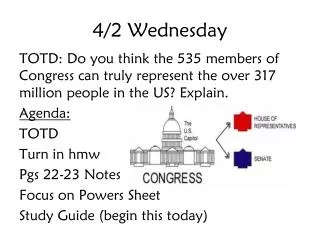
4/2 Wednesday TOTD: Do you think the 535 members of Congress can truly represent the over 317 million people in the US? Explain. Agenda: TOTD Turn in hmw Pgs 22-23 Notes Focus on Powers Sheet Study Guide (begin this today)
Limited Government • Can’t suspend the: • Writ of Habeas Corpus- • Court order that requires police to bring a prisoner to court to explain why they are holding the person • Can’t pass any: • Bills of Attainder • Laws that punish a person w/o access to a jury trial • Ex post facto laws • Laws that make an act a crime after the acthasbeen committed -Article One -Congress is given certain powers -defined in Article 1 of the Constitution -Congress is denied certain powers -defined in Article 1 • What Congress can’t do: • Can’t favor one state over another • Can’t tax interstate trade • Can’t tax exports
Expressed Powers • -Expressed (written in constitution), Delegated, Enumerated, Exclusive are all the same • -Powers given to Congress in Article One • -Examples: • Money: • Can collect taxes • Borrow $ • Coin $ • Military: • Can declare war • Can raise an army
Implied Powers -Powers given to Congress by the Necessary and Proper Clause • NOT written in Const! • Aka the ELASTIC CLAUSE -Interpretation of the Constitution Examples: (expressed) Power to tax and collect taxes implies: (implied)the power to support school (implied)Power to draft
Additional Powers -Power to Investigate • This is an example of checks and balances -Power to Propose Amendments -Power to Impeach: • Impeach- formally accuse officials of misconduct
Powers of the House -Must start all Appropriation Bills -”power of the purse”-- Power of the House whereby all revenue producing bills must be introduced in the House of Representatives **authorization bills- allow beginning of projects and AUTHORIZE how much $ can be spent ** appropriation bills-provide $ for each program/decide how much will be appropriate to spend -Picks President if no winner (tie) in Electoral College -Begins the Impeachment Process • No gov’t agency can spend $ w/o approval from Congress
Powers of the Senate -Approves Presidential Appointments • “Pres appoints, Senate approves” -Approves all Treaties “Pres appoints, Senate approves” -Acts as jury in Impeachment cases
Other Limits • If both houses of Congress can get 2/3 vote they can override a Presidential veto! -10th Amendment • Remember: any powers denied to national gov’t (congress) and given to STATES -Checks and Balances System • Each branch of gov’t exercises some control over the others! • Examples of checks and balances: • Supreme Ct can declare laws established by Congress unconstitutional • President can veto bills passed by congress before they become laws -Two Party System