

SlideServe
Menu
Préférences
© SlideServe · v2026

Drone Bee

ata avatar
7 diapositives · 1.2K Views · Jul 16, 2014

Drone Bee. By Andrew Flaherty and Laurent Sainte-Marie. The Drone Bee. What does it do?
Drone Bee - slide 1
01 / 7Drone Bee
1 / 17

Télécharger la présentation

Drone Bee
Une image / un lien ci-dessous est fourni (tel quel) pour télécharger la présentation

Politique de téléchargement : le contenu du site vous est fourni TEL QUEL pour votre information et votre usage personnel ; il ne peut être vendu, concédé sous licence ni partagé sur d’autres sites sans l’accord de son auteur.Le contenu vous est fourni TEL QUEL, pour votre information et votre usage personnel uniquement. Téléchargez la présentation en cliquant sur ce lien. Lors du téléchargement, si vous ne parvenez pas à télécharger une présentation, l’éditeur a peut-être supprimé le fichier de son serveur.Pendant le téléchargement, si vous ne parvenez pas à obtenir une présentation, le fichier a peut-être été supprimé par l’éditeur.

F I N

Plus de contenu associé

Transcription de la présentation
  1. Drone Bee By Andrew Flaherty and Laurent Sainte-Marie

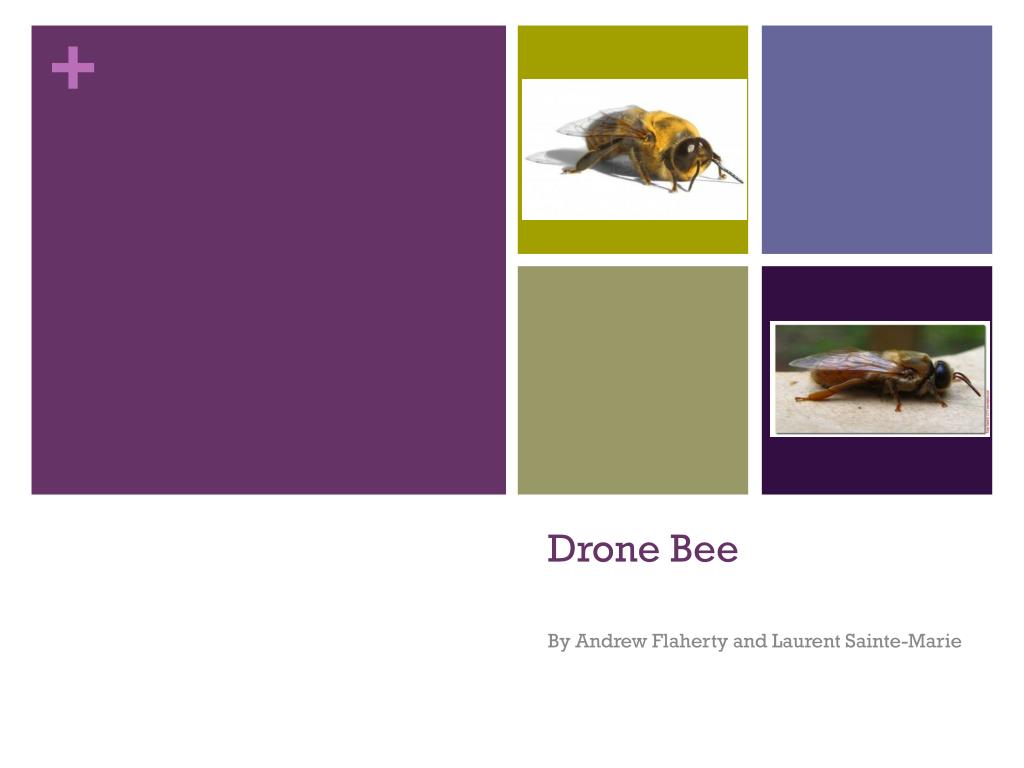
  2. The Drone Bee • What does it do? • This is a drone, a male bee. These bees do not sting so they are harmless. They live out their lives for one thing: to mate with a queen to start a new colony. Mature drones will leave the hive and gather with other drones in hopes of a virgin queen dropping in to mate with several of them. Once mated the drones die seconds later. Drones can not feed themselves or gather food, the worker bees feed the drones and they feed the queen too.

  3. Characteristics of drone • A drones eyes are bigger than other types of bees in the colony • The drones’ feet, head, and glands are different then the workers • Its abdomen is plumper than the others • It does not have a stinger • Its hairs, mandibles, and antennae are all longer than the others

  4. Mating and the drone reproductive organ • The drone penis is designed to disperse a large quantity of seminal fluid and spermatozoa with great speed and force. The penis is held internally in the drone (an endophallus). During mating, the organ is everted (turned inside out), into the queen. The eversion of the penis is achieved by contracting abdominal muscles, which increases hemolymph pressure, effectively "inflating" the penis. Claspers at the base of the penis help to grip the queen. Mating between a single drone and the queen lasts less than 5 seconds, and it is often completed within 1-2 seconds. Mating occurs mid-flight, and 10-40m above ground. Since the queen mates with 12±7 drones, and drones die post-mating, each drone must make the most of his single shot. The drone makes first contact from above the queen, his thorax above her abdomen, straddling her. He then grasps her with all six legs, and everts the endophallus into her opened sting chamber. If the queen’s sting chamber is not fully opened, mating is unsuccessful, so some males that mount the queen do not transfer semen. Once the endophallus has been everted, the drone is paralyzed, flipping backwards as he ejaculates. The process of ejaculation is explosive—semen is blasted through the queen’s sting chamber and into the oviduct. The process is sometimes audible to the human ear, akin to a "popping" sound. The ejaculation is so powerful that it ruptures the endophallus, disconnecting the drone from the queen. The bulb of the endophallus is broken off inside of the queen during mating—so drones only mate once, and die shortly after. The leftover penis remaining in the queen’s vagina is referred to as the “mating sign”. The plug will not prevent the next drone from mating with the same queen, but may prevent semen from flowing out of the vagina.

  5. Development Drones will die off or are ejected from the hive by the worker bees in late autumn, and do not reappear in the bee hive until late spring.

  6. Life cycle of drone honey bee Egg3 daysAdult dies after mating Adult 24 days 85-86 days dies Eats honey, nectar, and pollen. Larva 6 ½ days Eats drone jelly Pupa 14 ½ days Cell capped 10 days

  7. Bibliography http://en.wikipedia.org/wiki/Drone_(bee) http://www.hivetool.com/guide/dronebee.htm http://en.wikibooks.org/wiki/Beekeeping/Drone_Bee Normand Talbot, J’aimeraisConnaitre… Les Abeilles, Vol. 2, Regenstiener Publishing Enterprises INC. Quebec, 1972