Download
1 / 10
100 likes | 241 Vues
Discover the fascinating element Tellurium (Te), a semi-metallic substance known for its silvery-white appearance and unique chemical properties. With an atomic number of 52 and an atomic weight of 127.6, Tellurium melts at 449.5°C and boils at 988°C. It has a trigonal crystal structure and is primarily found in the p-block of the periodic table. This element is crucial in applications like preventing corrosion in lead and is also used in glass staining. Explore Tellurium’s behavior in reactions and its byproduct formation during copper refining.

E N D
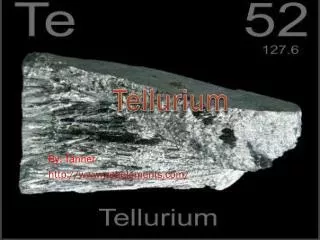
Tellurium By: Tanner http://www.webelements.com/
A silvery-white structure Is Semi-metallic Has a melting point of 449.5 C Has a boiling point of 988 C Physical Properties
Tellurium’s space group is P3121. It has a trigonal structure. Cell parameters: a: 445.72 pm b: 445.72 pm c: 592.9 pm α: 90.000° β: 90.000° γ: 120.000° crystal structure
Atomic Number: 52 Atomic Weight:127.6 Protons: 52 Electrons: 52 Neutrons: 76 Symbol: Te Basic Facts
Block: p-block Period:5 Group:16 Electron configuration: [Kr].4d10.5s2.5p4 Location on Periodic Table
Tellurium is an addition to lead to prevent corrosion Uses of Tellurium
Tellurium is also used to stain glass windows. USES OF Tellurium
Most tellurium is made as a byproduct of copper refining. Often found in humans Where to find Tellurium
Tellurium burns in air to formthe dioxide tellurium. Tellurium does not react with water under normal conditions. Tellurium reacts with fluorine and burns to form the hexafluoride tellurium fluoride. Tellurium has a negative 2 charge. Reactants
The group of people that made this video have made a video of most of the other elements. http://www.youtube.com/watch?v=5ChFbVu4Mpk Youtube video