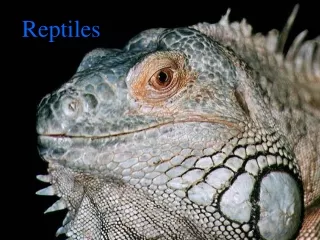
Reptiles
Reptiles. Diversity. Diversity Found on every continent but Antarctica Mainly found in tropics and subtropics Produce some heat Do not generate enough to maintain constant body temp (still ectothermal /cold-blooded) Good for reptiles—don’t have to eat to maintain body temp. Diversity.

Reptiles
E N D
Presentation Transcript
Diversity • Diversity • Found on every continent but Antarctica • Mainly found in tropics and subtropics • Produce some heat • Do not generate enough to maintain constant body temp (still ectothermal/cold-blooded) • Good for reptiles—don’t have to eat to maintain body temp
Diversity • Diversity • Reptiles included amniotes – those animals who produce a shelled, amniotic egg • Do NOT INCLUDE birds and mammals • Examples include: • Crocodiles, alligators, lizards, snakes, and turtles, Komodo dragon • Grouped together as the class Reptilia • Latin repere means "to creep"
General Characteristics • Reptiles are tetrapods • Vertebrates with four legs • Contain tough keratinized skin • Provides protection against injury • Scales or bony plates (well-developed dermal layer) • Contain chromatophores • Excretory system • Two small kidneys. • Uric acid is the main waste product.
General Characteristics • Contain powerful jaws • Desgined for applying crushing or gripping force • Used to kill/capture prey • FYI: Fish/Amphibian jaws designed for quick closure (with little pressure/force) • Reptile muscles (in jaw) are larger, longer and arranged to apply a strong grip
General Characteristics • Circulatory system • Most reptiles have closed circulation • Contain a three-chamber heart • Consisting of two atria and one ventricle. • There is little mixing of oxygenated and deoxygenated blood in the three-chamber heart.
General Characteristics • Organs for water retention • Metanephric kidneys: • excretes uric acid or urea which allows them to occupy terrestrial habitats • Salt glands: • Located near nose/eyes • Secretes a salty fluid • All reptiles have better body support and more efficiently designed limbs for travelling on land
General Characteristics • Circulatory system • Exceptions to these characteristics: • Crocodilians have a complicated four-chamber heart • This heart is capable of becoming a functionally three-chamber heart (during dives) • Some snake and lizard species (e.g., monitor lizards and pythons) have three-chamber hearts that become functional four-chamber hearts (during contraction)
General Characteristics • Respiratory system • All reptiles breathe using lungs. • VERY well developed lungs • Only a few use skin to breathe (sea snakes) • Most reptiles do NOT have a muscular diaphragm (like mammals) • Crocodilians have a muscular diaphragm • Turtles & Tortoises. • Aquatic turtles have developed more permeable skin, and even have gills in their anal region
General Characteristics • Nervous system • Advanced nervous system compared to amphibians. • 12 pairs of cranial nerves. • Hearing is underdeveloped • All other senses are highly developed • Small brain (but, cerebrum is large) • Contain Jacobson’s organ • Specialized organ for smell (odors carried to this organ via the tongue)
General Characteristics • Reproduction system • Most reptiles reproduce sexually. • Asexual reproduction has been identified in in six families of lizards and one snake. • No larval stages. • Internal fertilization (copulatory organs) • Sperm – testes, Egg - ovaries
General Characteristics • Reproduction system, cont. • Contain amniotic egg • Permits rapid development of large young in relatively dry environments • Provides nourishment for growing embryo • Provides protection (shell) from environment • Allows for sufficient gas exchange • Reduces water loss
Classification • Kingdom Animalia • Phylum Chordata • Class Reptilia • They are represented by four surviving orders: • Crocodilia • Rhynchocephalia • Squamata • Testudines
Classification • Order Crocodilia • Ex: crocodiles, caimans and alligators • 23 surviving species • Body shape: elongated, robust, reinforced skull and massive jaw muscle structure • Teeth in sockets • Four-chambered heart • Can vocalize • Oviparous (eggs are guarded heavily by mother) • Will lay 20-50 eggs at a time Male Crocodile courtship
Classification • Rhynchocephalia • Ex: tuataras from New Zealand • 2 surviving species • Lizard-like body form • Slow-growing animals that live in burrows • VERY good eyesight (have cornea, lens and retina)
Classification • Squamata • Ex: lizards, snakes, (specific ex: gila monster, python, monitor lizard) • Approximately 7,600 species • Most diverse group of reptiles • Kinetic skull (mobile/moveable) • May contain fangs (with poison) • May contain heat-sensing organs (pit organs – in pit vipers)
Classification • Testudines • Ex: turtles, tortoises • Approximately 300 species • Enclosed in shells consisting of carapace and plastron (breastplate) • No teeth, but contain keratinized plates inside mouth for gripping food • Oviparous • Nest temperatures determine sex of offspring • Low temp = males, high temp = females