Quantum Simulation Parameters Optimization
230 likes | 341 Vues
Explore the impact of increasing parameters in quantum simulation calculations and analyze results. Study parameter ranges to enhance accuracy and efficiency. Experiment with different system configurations and symmetry types to evaluate computational performance.


Quantum Simulation Parameters Optimization
E N D
Presentation Transcript
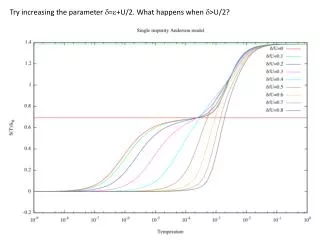
Try increasing the parameter d=e+U/2. What happens when d>U/2?
Verify the formula for TK, by performing the calculation for a range of G and plotting lnTK vs. G.
Decrease systematically keepenergy from 10 to small values. How does the quality of the results deteriorate?
Increase L (to 4, then to 8). Try to do the z-averaging with a different number of z values.
Change the symmetry type from QS to QSZ. How much slower is the calculation? ISO All: 10 s QS All: 58 s QSZ All: 394 s SPSU2 All: 490 s SPU1 All: 3452 s
For SIAM, plot n_d for a sweep of the parameter d. Notice how the occupancy is pinned to 1 in a wide interval of d.
For Kondo model, calculate the spin polarization SZ for a S=1 Kondo model for a range of magnetic field B going from negative to positive values.
Increase d to large values. How is the low-energy fixed point affected? Compare the flow diagrams for even and odd chain lengths.