150 likes | 266 Vues
Research indicates that high-fat diets can significantly enhance athletic performance by increasing energy availability and muscle glycogen content. Over a period of 3-4 weeks, a diet supplemented with 10% fat has shown benefits such as higher muscle glycogen levels before exercise, decreased heat production, and improved endurance and sprint performance. Athletes can achieve 60% more energy availability with an unchanged diet energy intake, ultimately delaying fatigue during both anaerobic and aerobic activities. These findings highlight the importance of strategic fat inclusion in athletic training regimens.
E N D
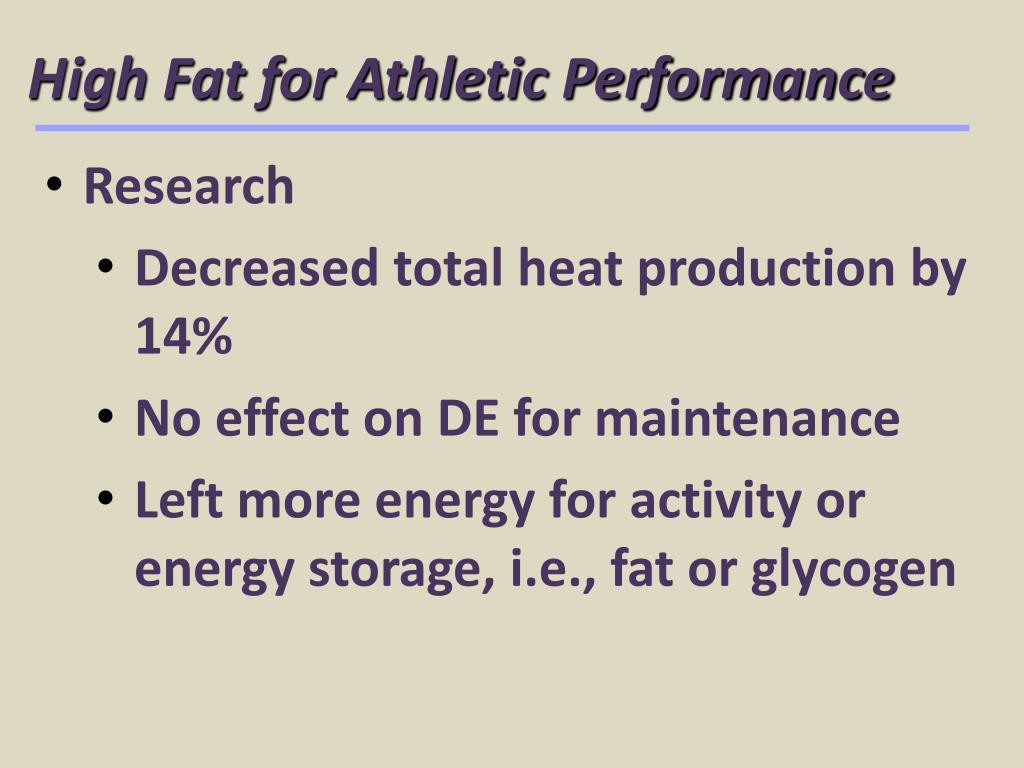
High Fat for Athletic Performance • Research • Decreased total heat production by 14% • No effect on DE for maintenance • Left more energy for activity or energy storage, i.e., fat or glycogen
High Fat for Athletic Performance • Research • Unchanged DE intake • Decreased DE for maintenance • 60% more energy available
High Fat for Athletic Performance • Several benefits • Increases muscle glycogen content • Must be fed for > 3-4 weeks • Muscle glycogen increased with increasing fat, up to 10-12% fat
High Fat for Athletic Performance • Several benefits • Increases muscle glycogen use during anaerobic activity (sprint) • Glycogen & glucose major substrates for anaerobic energy
High Fat for Athletic Performance • Several benefits • Less muscle glycogen use during aerobic activity (endurance) • Helps delay fatigue
High Fat for Athletic Performance • Research • Muscle glycogen higher before exercise • At sprint – muscle glycogen use higher • 14/15 TB ran faster race times when fed fat-supplemented diet
High Fat for Athletic Performance • Research • Endurance – trotted 35 min before HR reached 160/min • w/o fat 160/min reached at 20 min • Cutting horses fed high-fat were able to work harder
High Fat for Athletic Performance • Recommendation • Fat enhances both aerobic and anaerobic performance • Fat delays fatigue • Feed fat 6 to 10 weeks prior to competition • Feed up to 10% fat
Energy Values of Feeds • Not found on feed label???????
DE & CF Relationship in Horse Grains Lewis, Lon D. 1996. Feeding and Care of the Horse.
Energy Values of Feeds • For dry forages, roughages, pasture, range plants, and forages fed fresh: • DE (Mcal/kg) = 4.22 – 0.11(%ADF) + 0.0332(%CP) + 0.00112(%ADF)2 • (NRC, 2007)
Energy Values of Feeds • For energy feeds and protein supplements: • DE (Mcal/kg) = 4.07 – 0.055(%ADF) • (NRC, 2007)
Energy Values of Feeds • To adjust energy content of high fat feeds: • Increase DE by 0.044 Mcal/kg for each 1 percent fat above 5 percent • (NRC, 2007)
Energy Values of Feeds • Use “horse” energy values • Energy values on feed analysis are usually calculated for ruminants • Horses digest forages less effectively than ruminants, so energy values for forages are not the same