Download
1 / 23
230 likes | 355 Vues
This document delves into the fascinating lives and musical contributions of three iconic composers—Frédéric Chopin, Franz Liszt, and Felix Mendelssohn. Chopin, known as “The Poet of the Piano,” created exquisite works predominantly for piano, emphasizing lyrical beauty and expressive capabilities. Liszt revolutionized piano technique and was a remarkable showman while Mendelssohn catalyzed the Baroque revival and was a master pianist and conductor. Learn about their personal lives, performance styles, and unique compositional approaches, and listen to selected pieces that exemplify their genius.

E N D
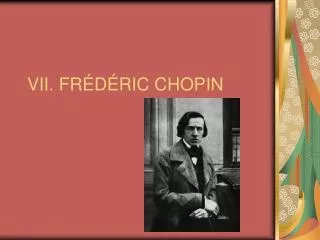
“The Poet of the Piano” – only great composer who wrote almost exclusively for piano • Raised in Warsaw, Poland • Main airport in Poland is named after him • Moved to Paris at 21, stayed the rest of his life
Friends with Victor Hugo (poet), Delacroix (painter, Liszt and Berlioz • Shy, disliked crowds, preferred to play in salons rather than concert halls • Frail physique • Difficulty drawing big sounds out of the piano • Known for tone, rhythmic flexibility, atmospheric use of the pedal
Elegant, fashionable • Lived in luxury • Met Aurore Dudevant • Well-known novelist, pen name: George Sand • Feminist, often wore men’s clothing, smoked cigars, fought for sexual freedom
Became lovers when Chopin was 28 and she was 34 • Chopin thrived on her care, composing many of his greatest works in the 9 years they lived together • After their split, his health deteriorated and he composed very little
Chopin’s Music • Relatively small body of work compared to other composers • Most pieces short, but exhibit infinite variety of moods • Elegant and graceful • Seen as the composer who best wrote for piano and its expressive ability
Music lends well to rubato for heightened expression • Lends a poetic and improvisatory quality to his music
LISTENING TO CHOPIN Nocturne in E Flat Major, Op. 9, No. 2 Written when he was about 20 Nocturne – (“night piece”) slow, lyrical, intimate composition for piano Books pg. 302
LISTENING TO CHOPIN Étude in C Minor, Op. 10, No. 12 (Revolutionary) Étude – study piece designed to help a performer master specific technical difficulties The Revolutionary develops speed and endurance in the left hand Books pg. 304
VIII. FRANZ LISZT 1811-1886
Handsome, long-haired, magnetic personality • Born in Hungary • Studied in Vienna, met Beethoven and Schubert • By age 19, already known as a brilliant pianist
Incredible showman, irresistable to women • Age 36: abandoned traveling, became court conductor for Duke of Weimar • Composed orchestral works • Taught students free of charge • One of the most unselfish and generous musicians who ever lived • Was known to provide financial support to Wagner
Active writer, publishing music criticism and books on Chopin and other topics
1861 – resigned Weimar, went to Rome, took holy orders in 1865 • Contemporaries thought this strange • “Don Juan: Holy Man” • Composed masses, oratorios • Last 17 years of his life: traveled again • Wrote some experimental piano music that foreshadowed some 20th c. music
Liszt’s Music • Controversial—some think it’s vulgar, bombastic; others revel in its extroverted romantic rhetoric • Found new ways to exploit piano—unprecedented range of dynamics • Created symphonic poem, or tone poem—a one-movement orchestral composition based to some extent on literary or pictorial ideas • Highly influential on other composers
LISTENING TO LISZT Transcendental Étude No. 10 in F Minor (1851) Books pg. 309-310
IX. FELIX MENDELSSOHN 1809-1847
Born in Hamburg, Germany • From wealthy, famous family • Father: banker • Grandfather: Jewish philosopher Moses Mendelssohn • Age 9: brilliant pianist • Age 13: had written symphonies, concertos, sonatas, vocal works
Age 20: conducted Bach’s St. Matthew Passion—first time since Bach’s death, started Baroque revival • Often performed as pianist/organist • Age 26: became conductor of the Leipzig Orchestra—transformed it into one of the finest groups in Europe
Also painter, writer, brilliant conversationalist in 4 languages • Happily married, father of 4 • Died at age 38 of a stroke
LISTENING TO MENDELSSOHN Concerto for Violin and Orchestra in E Minor, Op. 64 Books pgs. 312-316
HOMEWORK • Compare and contrast the following composers in 3 categories: • personal life, performance abilities, compositional style Frederic Chopin, Franz Liszt, Felix Mendelssohn This Thursday: Group work in the Media Center