Understanding RVR: Deriving Visual Segments from ICAO Approach Lengths
This article explains the formula for Runway Visual Range (RVR) in aviation, emphasizing the calculation of visual segments based on height above terrain (HAT), the tangent of the glide slope angle (tg.x), and significant parameters like ICAO maximum approach light length. By breaking down the equation RVR = HAT/tg.x - L, we see how RVR results from the combination of variables X and Y. The pilot's visibility relies on these calculations, which include additional segments that extend beyond standard measurements, ensuring safe landings.

Understanding RVR: Deriving Visual Segments from ICAO Approach Lengths
E N D
Presentation Transcript
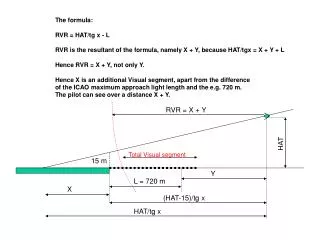
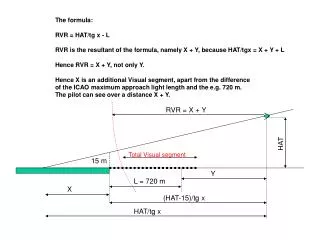
The formula: RVR = HAT/tg x - L RVR is the resultant of the formula, namely X + Y, because HAT/tgx = X + Y + L Hence RVR = X + Y, not only Y. Hence X is an additional Visual segment, apart from the difference of the ICAO maximum approach light length and the e.g. 720 m. The pilot can see over a distance X + Y. RVR = X + Y HAT Total Visual segment 15 m Y L = 720 m X (HAT-15)/tg x HAT/tg x