
Uploaded by
aurora
0 SLIDES
340 VUES
0LIKES
Light
DESCRIPTION
Chapter 16. Light. Light. The Ray Model of Light was introduced as a way to study how light interacts with matter Ray= a straight line that represents the linear path of a narrow bean of light Rays can change direction if reflected or refracted. Light Sources.
Download

1 / 0
Download Presentation

Télécharger la présentation
Light
An Image/Link below is provided (as is) to download presentation
Download Policy: Content on the Website is provided to you AS IS for your information and personal use and may not be sold / licensed / shared on other websites without getting consent from its author.
Content is provided to you AS IS for your information and personal use only.
Download presentation by click this link.
While downloading, if for some reason you are not able to download a presentation, the publisher may have deleted the file from their server.
During download, if you can't get a presentation, the file might be deleted by the publisher.
E N D
Presentation Transcript
- Chapter 16
Light
- Light The Ray Model of Light was introduced as a way to study how light interacts with matter Ray= a straight line that represents the linear path of a narrow bean of light Rays can change direction if reflected or refracted
- Light Sources There are MANY different sources of light but there are only two TYPES of sources 1. Luminous Source = an object that emits light (such as the sun or a candle) 2. Illuminated Source = object that becomes visible as a result of the light reflecting off it (such as the Moon)
- Properties of Light The illuminance produced by a point source is proportional to 1/r2 (the inverse square law)
- More “Stuff” Speed of Light (c) = 3.00 x 10⁸ m/s Diffraction = the bending of light around a barrier
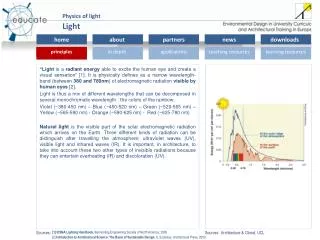
- Electromagnetic Spectrum As the wavelength of visible light decreases, the color changes from red to violet As wavelength decreases, the frequency increases, and the energy of the wave increases
- Electromagnetic Spectrum
- Primary Colors of Light Primary colors of light = red, green, and blue Secondary colors=yellow, cyan, and magenta
- Color Complementary colors = 2 colors of light that can be combined to make white light Objects appear a certain color because they reflect that color light and absorb all the others
- Polarization Polarization is the production of light in a single plane of oscillation
- Seeing Light Doppler Shift= the difference between the observed wavelength of light and the actual wavelength ∆λ=(λobs- λ)=+/- (v/c) λ
- Doppler Shift A positive change in λ = red shift The relative velocity of the source is away from the observer A negative change in λ = blue shift The relative velocity of the source is towards the observer
- Doppler Shift Stellar motion take the spectrum of a star compare observed wavelengths of absorption lines to lab values (H, Fe, Na, etc.) calculate star’s radial motion (need distance and tangential angular motion to get space motion) NO, you won’t have to calculate this!!!
- Chapter 17
Mirrors
- Videos Light, Lenses, and Lasers Telescopes Archimedes Death Ray
- Reflection Reflection is the change in direction of a wave at an interface between two different media so that the wave returns into the medium from which it originated. Law of reflection: the angle of reflection=the angle of incidence θr=θi
- Reflection Specular reflection = when light hits a smooth surface the rays are reflected in parallel Diffuse reflection = when light hits a surface that is rough (on the level of the wavelength of light) the light scatters
- Reflection Reflected rays of light that enter the eye appear to originate at a point behind the mirror Virtual image= a type of image formed by diverging light rays Always on the opposite side of the mirror from the object
- Chapter 18
Refraction and Lenses
- Refraction Refraction= the bending of light as it passes into a new medium
- Refraction Index of Refraction= the ratio of the speed of light in a vacuum to the speed of light in that medium The index of refraction determines how much the light bends/refracts n=c/v
- Total Internal Reflection Phenomenon that occurs when light traveling from a region of a higher index of refraction to a region of lower index of refraction strikes the boundary at an angle greater than the critical angle such that all light reflects back into the region of higher index Critical angle = the angle of incidence above which total internal reflection occurs
- Total Internal Reflection
- Chapter 19
Interference and Diffraction
- Interference Incoherent light = light with unsynchronized wave fronts that illuminates objects with an even, white light EX: the light you see when you look at objects illuminated by a light bulb Coherent light= light from two or more sources that add together in superposition to produce smooth wave fronts
- Interference Interference fringes = a pattern of light and dark bands on a screen, resulting from the constructive and destructive interference of light waves passing through two narrow, closely spaced slits in a barrier
- Interference Thin-film interference : a phenomenon in which a spectrum of colors is produced die to the constructive and destructive interference of light waves reflected in a thin film
- Diffraction The phenomenon of diffraction involves the spreading out of waves past openings which are on the order of the wavelength of the wave Diffraction pattern : a pattern on a screen of constructive and destructive interference of Huygens’ wavelets
- Diffraction Diffraction Grating = a device made up of many single slits that diffract light and form a diffraction pattern that is an overlap of single-slit diffraction patterns The tracks of a compact disc act as a diffraction grating, producing a separation of the colors of white light.
- Color Puzzles WOOT!


More Related

Audio
Live Player