Understanding Light Refraction and its Role in Eye Function and Optical Instruments
This text explores the phenomenon of light refraction, detailing how light bends when transitioning between different media. It explains the role of lenses—convex and concave—in converging and diverging light, respectively. The description of how lenses form images, including the concept of dispersion when white light passes through a prism, helps illustrate color perception. Additionally, it discusses the anatomy and functioning of the eye, comparing it to a camera, and identifies common eye defects, such as short-sightedness and far-sightedness, along with their corrective lenses.

Understanding Light Refraction and its Role in Eye Function and Optical Instruments
E N D
Presentation Transcript
Light Refraction and the Eye
Refraction • Refraction is the bending of light when it moves from one medium to another. • When it travels from one medium to a thicker medium it slows down. • When it travels from one medium to a less dense medium it speeds up.
Lens • These are thick pieces of transparent materials. • When light passes through them it refracts. • There are two types of lens: convex and concave. • A convex lens converges light. • A concave lens diverges light.
Uses of lens • The eye • Cameras • Telescopes • Periscopes • Microscopes • Kaleidoscopes • Projectors
Image from a lens • The image formed by a lens is called a real image. • It is inverted (upside down). • It is usually smaller. • It can be shown on a screen.
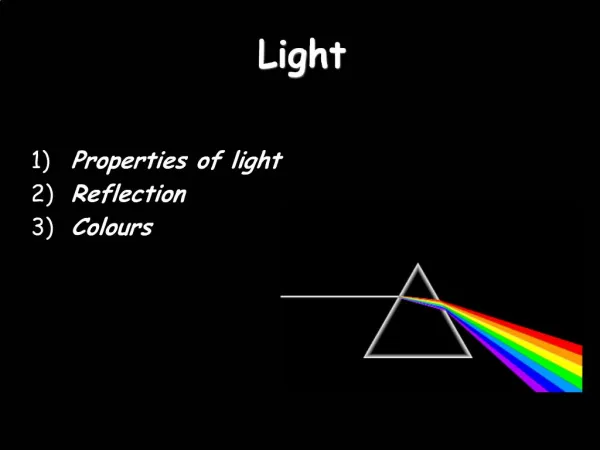
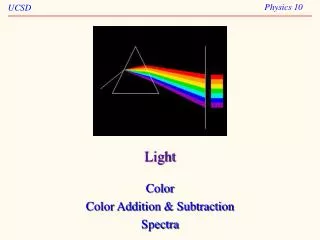
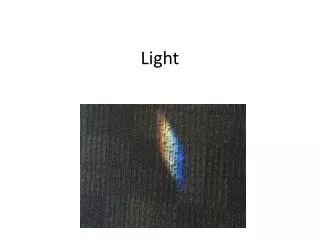
Dispersion • Light that comes from the sun is called white light. It is made up of seven colours combined. • The seven colours are ROY G BIV. • Whenever sunlight or white light passes through a special lens called a prism it refracts • When white light refracts through a prism it splits into the seven colours. This is called dispersion • This is how a rainbow is formed.
How do we see colours? • All materials absorb light. • However they also reflect light. • Remember white light is made up of seven colours. • We see colours when materials absorb the white light and then only reflect one of the seven colours back to you.
The Eye- an organ that allows us to perceive light. • The parts of the eye are: • Pupil • Retina • Cornea • Ciliary muscles • Lens • Iris • Fovea • Aqueous humor • Vitreous humor • Optic nerve
How the eye works. • Light enters through the cornea, passes through the pupil, refracts through the lens and forms an image on the retina. • This image is then sent to the brain through the optic nerve.
The eye is similar to a camera • The retina is just like the film. • The eye’s lens I just like a camera’s lens. • The ciliary muscles are like focusing your camera. • The iris is just like the shutter. • The pupil is just like an aperture.
Defects of the eye. • Two common eye defects are: • Short sight –A person can only see near. The image is formed inside in the middle of the eye. A person has to use concave lens. • Far sight – A person can only see far. The image is formed outside in the back of the eye. A person has to use a convex lens.