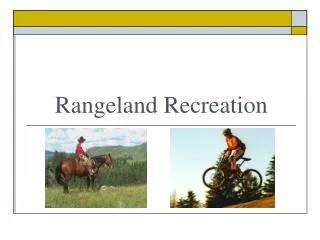
Rangeland Recreation
180 likes | 325 Vues
Recreational use of rangeland is on the rise as more urban populations seek natural escapes. Traditional activities like camping and hiking thrive alongside thrill-based pursuits such as rock climbing. While hunting remains a key sport, its popularity declines. The economic benefits of recreation are undeniable, yet individual actions often lead to significant cumulative environmental impacts. Education and monitoring are crucial for sustaining both enjoyment and environmental health. Effective management strategies are needed to mitigate negative effects while maximizing community and resource benefits.


Rangeland Recreation
E N D
Presentation Transcript
Rangeland Recreation Jen Peterson
Recreational on rangeland is increasing • Changing recreation types • Upward trend in thrill-based activities like rock climbing • Technology is allowing new types of recreation (i.e., off-road vehicles) • Hunting - still a major sport but decreasing • Traditional activities like camping, hiking, and horseback riding continue strong and growing
Demographics favor recreation on public lands • Urbanization has created a populations with a desire to “get out of town” & enjoy nature • Most people now live in towns/cities did not grow up on farms & have few rural connections. • Recreation is one of their few connections with the land. • Growing willingness to spend money on recreation.
Economically Potent • Pros • Cons
Often perceived as “benign” • People don’t see impact of their individual activity • Cumulative impacts are serious but there is little one person can do to reduce or increase this impact • Lack of data - many people don’t realize or notice the impact that recreation has on the land. • Impacts of specific types of recreation vary – some are very hard on the land and others are quite benign.
Extractive vsAmenity uses • Varying impacts: • Extractive = removal of something from environment • Amenity = enjoyment, comfort • Education plays a role in affecting impacts • Recreation may be some peoples only contact with nature
Impacts of recreational uses - Positive • Economics to community • Economics for resource improvement & protection • $$ to lessen impact • Education “connection to land” • Trail development for wildlife and livestock • Weed & fire monitoring . • Monitoring dumping/trash (self policing) • Hunting/fishing to maintain wildlife/fish
Impacts of recreational uses - Positive • Economics to community • Economics for resource improvement & protection • $$ to lessen impact • Education “connection to land” • Trail development for wildlife and livestock • Weed & fire monitoring . • Monitoring dumping/trash (self policing) • Hunting/fishing to maintain wildlife/fish
Impacts of recreational uses - Negative • Death of wildlife (abandon young) • Attracts animals to people (dangerous) • Fire • Weeds • Erosion & compaction • Water contamination • Disturbing with wildlife • Displacing wildlife (water and forage) • Trash and other dangers • Can alter habitat (human browse line)
Impacts of recreational uses - Negative • Death of wildlife (abandon young) • Attracts animals to people (dangerous) • Fire • Weeds • Erosion & compaction • Water contamination • Disturbing with wildlife • Displacing wildlife (water and forage) • Trash and other dangers • Can alter habitat (human browse line)
For Example – Impact on Wildlife Effect of Hikers on Mule Deer Study by Knight & Miller –Boulder, Colorado
For Example – Impact on Wildlife Effect of Hikers on Vesper Sparrow Study by Miller & Knight –Boulder, Colorado
For Example – Impact on Wildlife Effect of Hikers vs Mountain Bikers on Bison, Deer & Pronghorn Study by Miller & Knight –Antelope Island, Utah
Can Wildlife Adjust? • Leaned response • Avoidance -- • Attraction -- • Habituation -- • Genetic response
Conflicts Between Recreationists • Motorized vs non-motorized • Sound, litter, etc. • Presence of other people • Impacts
Management Approaches • Rest • Close roads and trails • Adjust seasons • Limit areas of activity
Management Approaches • Change intensity • No fire use • Bad roads • Limited facilities • Fees • Foot only ... not motorized vehicles • Increase available facilities • Designate uses on specific areas
Survey of New Mexico Citizens • Percentages of New Mexico Citizens Ranking: • Environmental Preservation • Commerce • Recreation • as the Most Important Priority for Public Land Management