Understanding the Use of "y" and "en" in French Pronouns
This guide explores the French pronouns "y" and "en," focusing on their usage in everyday sentences. "Y" typically replaces phrases introduced by place prepositions (like à, dans), indicating location or direction, while "en" is used to replace phrases linked with de or to indicate quantity. Through examples, we will demonstrate how to replace nouns and address common questions. Learn how to enhance your conversational French by using these pronouns effectively!

Understanding the Use of "y" and "en" in French Pronouns
E N D
Presentation Transcript
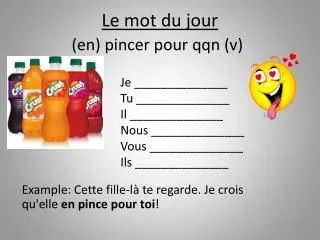
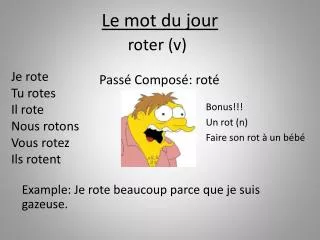
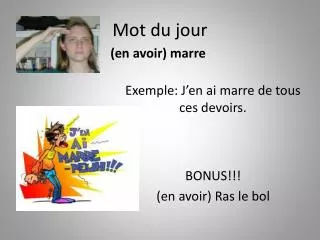
Mot du jour (en avoir)marre Exemple: J’enaimarre de tousces devoirs. BONUS!!! (en avoir) Ras le bol
10.4.2013 • MDJ • Notes on y and en • Une chanson
Y! • Remember this? • Est-cequetudonnes à Selena le cadeau? • Oui, je le luidonne. • À + person is replaced by me, te, lui, nous, vous, leur • But what about in sentences like these? • Vas-tusouvent à la plage? • Vas-tuchez ton copaincesoir?
Y! • Y= there (most of the time)!!! • Vas-tusouvent à la plage? • Oui, j’yvaissouvent. • Vas-tuchez ton copaincesoir? • Non, je n’yvais pas. • Y can replace names of places introduced by prepositions of place like à, en, dans, chez, etc. • Y can also replace à + NOUN (that’s a thing) • Tujoues au foot? • Oui, j’yjoue.
Y! • Vas-y! • On y va?! • Allons-y!
EN! • What do you notice? • Tufais du jogging? • Oui, j’enfais. • Vousavez fait de la gymnastique? • Oui, nous en avons fait. • Tuveux de l’eauminerale? • Oui, merci, j’enveuxbien. • Tu ne fais pas de ski, n’est-ce pas? • Non, je n’enfais pas.
What do you notice… • Tufais du jogging? • Oui, j’enfais. • Vousavez fait de la gymnastique? • Oui, nous en avons fait. • Tuveux de l’eauminerale? • Oui, merci, j’enveuxbien. • Tu ne fais pas de ski, n’est-ce pas? • Non, je n’enfais pas. • …about the position of en in relation to the verb? • …about what en means/replaces?
EN! • Tu as un iPod? • Oui, j’enai un. • Tu as unevoiture? • Non, je n’enai pas. • Tu as deux chats? • Non, maisj’enai un. • Marc a troischiens. Et toi? • J’enaideux. • Tuviens de la plage? • Oui, j’enviens. • Tuparles de tesprojets? • Non, j n’enparle pas. • Tu as besoin de ton livre? • Oui, j’enaibesoin.
EN! • Tu as beaucoup d’amis? • Oui, j’enai beaucoup • Tu as assezd’argent? • Non, je n’enai pas assez.
J’ai achete ces livres. • J’ai achete tes livres. • J’ai achete les livres. • J’ai achete des livres. • How wouldyou replace books in each of the sentences?