Download
1 / 8
80 likes | 192 Vues
In his address at the CAPAM Conference, Professor H. Ian Macdonald explores the intersection of research, innovation, and public policy. He emphasizes that effective public policy requires a grounded understanding of practical realities, and policy objectives must be preserved. Macdonald discusses the need for collaborative public-private research, highlighting experiences that shape policy-making, such as cost-benefit analysis and community engagement. By advocating for case-by-case evaluations and the importance of evidence-based approaches, he outlines key lessons for effective government service delivery.

E N D
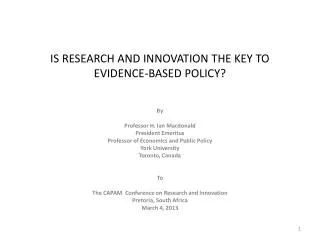
IS RESEARCH AND INNOVATION THE KEY TO EVIDENCE-BASED POLICY? By Professor H. Ian Macdonald President Emeritus Professor of Economics and Public Policy York University Toronto, Canada To The CAPAM Conference on Research and Innovation Pretoria, South Africa March 4, 2013
1. INTRODUCTION • theory can always be confounded by practice • policy objectives must never be readily discarded • no organization has a monopoly on public policy understanding, but may have ideological objectives • public policy research is not conducted in a laboratory • judgement is critical
2. The Political Master/The Research Subject • all governments share the objective of more efficient delivery of service • four experiences that bear on the question: who should do public policy research and to what degree? 3. The Four Experiences • research after the event • supportive cost-benefit analysis • the shared values of the public and private sector • garbage collection in the City of Toronto
4. Other Issues • short-term versus long-term • do outsiders really understand government • government organization and service delivery 5. Lessons to be Learned • the importance of proceeding on a case-by-case basis • the separation of policy and delivery • what can go wrong (the Brampton case) • the growth of implicit research
6. Conclusions • the importance of tackling these issues • We want evidence-based public policy not public policy- based evidence