Innovative Solar Panel System with Fresnel Lenses for Enhanced Energy Efficiency
The Ultimate Solar Panel (TUSP) project introduces a revolutionary solar panel system designed to maximize energy efficiency. By incorporating Fresnel lenses that capture more sunlight and a microchip-controlled tilting mechanism, TUSP adjusts solar panel positioning to maintain optimal sunlight exposure. Experimental data indicates an average voltage increase of 0.3 volts with lens use. The system features robust design with self-sustaining capabilities, effective voltage regulation, and smart control via the PIC 18F4620 microchip, ensuring reliable performance in varying conditions.


Innovative Solar Panel System with Fresnel Lenses for Enhanced Energy Efficiency
E N D
Presentation Transcript
TUSP: The Ultimate Solar Panel Giancarlo Mesa Jong In Kim Ian Mihalo
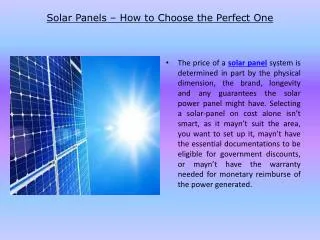
The Ultimate Solar Panel (TUSP) • TUSP is a light source following solar panel • Alternate energy source • Increases efficiency against panels that lay flat. • Outdoor test: As much as 1 volt increase when tilting the panel towards the sun as opposed to laying it flat. • Fresnel lenses will be placed over the top of each panel, increasing the amount of light the panels receive. • As the light source moves, the focal point created by the lens will gradually fall off of the board. • Sharp drop in output voltage from solar panels. • The drop in voltage will tell TUSP how to make corrective changes • These changes allow the panels to receive optimum conditions of light by tilting and/or rotating the panels to face the light source.
Experimental Data(Average) • On Average, the Fresnel lenses increased the output voltage by three tenths of a volt. • Still have to decide what threshold voltages will be • As anticipated, when the light source was moved, the focal point gradually fell off of the panel.
Changes in Design • Only using PIC 18F4620 Microchip • 4 analog voltage inputs needed • Voltage regulator Circuits • Microchip 5 volts • Motor 12 volts • Self-sustaining • 2 Rechargeable 9 volt batteries • Addition of Trickle charger circuit • Does not overcharge batteries
Specifications • 4 Solar Panels • 95.25 mm X 63.5 mm • 4Vdc, 100mA
Specifications • 4 Fresnel Lenses • 95mm X 135mm X 0.4mm • Focal Length 120mm • For best results, lenses will be placed at this length.
Specifications • 2 Stepper Motors • 4 Phase 12V, 40mA • 30 ohms Resistance • Angle: 7.5°/85.25 • Torque 350 g.cm
Motor Testing • Rotation • Clockwise • Counter Clockwise • Performance unimplemented • Smooth rotation • Performance implemented (solar panel inputs) • Choppy rotation • Sampling time
Technical Problems • Focal point acquisition • Correct response as source moves • Threshold changes constantly • Maximize efficiency • Testing needs to have constant environment • Finish code to give proper step response to stepper motors
Fresnel Lens Solar Panel Trickle Charger Batteries ~18v LCD PIC 18F4620 Regulator Circuitry Direction Control Stepper Motors
Summary • Changes in design: • Self-sustaining • Using the 18F4620 chip only • Trickle charger circuit • Properly charges the batteries • Voltage regulator circuit • Make sure components are not overloaded.