Enhancing Writing with Sentence Variety: Types and Techniques
60 likes | 182 Vues
This workbook delves into the four essential types of sentences that every writer should master: simple, compound, complex, and compound-complex sentences. By varying sentence structures, writers can avoid redundancy and maintain reader interest. Examples illustrate each type clearly, providing practical insights into their formation and usage. Understanding these sentence forms will equip you with the skills to create engaging essays and written works.


Enhancing Writing with Sentence Variety: Types and Techniques
E N D
Presentation Transcript
Sentence Variety I Sentence Skills: A Workbook for Writers, Form A John Langan
Sentence Variety There are, in fact, four different kinds of sentences. A good writer will vary the kinds of sentences he or she uses in an essay. This prevents their writing from seeming boring and redundant, and it keeps the reader interested. Hence, it is important to learn the four types of sentences, and to understand how to use them.
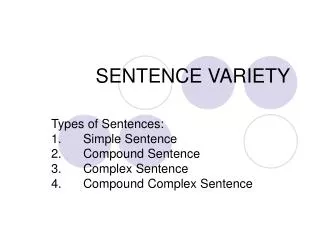
Simple Sentence • A simple sentence has a single subject-verb combination. For example: Joeruns. The dogate my homework. • A simple sentence can have more than one subject, more than one verb, or several subjects and verbs.
Compound Sentence • A compound sentence is made up of two or more simple sentences. Usually, the two complete statements are connected by a commaand a joining word. For example: The dogate my homework, so Iam in trouble. Jo-Jowas in Tuscon, and Loretta wasin San Diego.
Complex Sentence • A complex sentence is made of a complete simple sentence and a statement that begins with a dependent word (such as:although, before, that, which.) For example: The dogate my homework, although I told him not to. Jo-Jowas in Tuscon, which is very strange.
Compound-Complex Sentence • A compound-complex sentence is made up of two (or more) simple sentences and at least one dependent statement. For example: Before my dog arrived, I always handed in my homework, and I always got perfect grades. Unless you come over here, Jo-Jo will go back to Tuscon, and Loretta will start to cry.