Understanding Security Protocols in Distributed Operating Systems: Authentication and Protection
280 likes | 385 Vues
This article delves into various security protocols and methodologies employed in distributed operating systems, focusing on authentication and protection against security threats. It explores the effectiveness of approaches like encryption, symmetric and asymmetric key exchanges, and the implementation of digital signatures to ensure secure communications. Key topics include challenges posed by unauthorized access, IP spoofing, nonce utilization, and the risks of man-in-the-middle attacks. The use of message digests and hash functions for data integrity is also discussed, providing insights into how distributed systems can authenticate entities and protect against invalid operations.


Understanding Security Protocols in Distributed Operating Systems: Authentication and Protection
E N D
Presentation Transcript
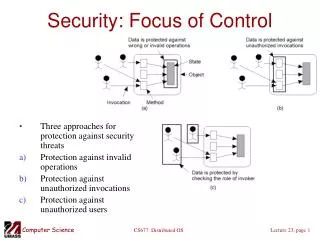
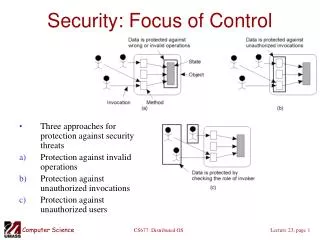
Security: Focus of Control • Three approaches for protection against security threats • Protection against invalid operations • Protection against unauthorized invocations • Protection against unauthorized users CS677: Distributed OS
Authentication • Question: how does a receiver know that remote communicating entity is who it is claimed to be? CS677: Distributed OS
Authentication Protocol (ap) • Ap 1.0 • Alice to Bob: “I am Alice” • Problem: intruder “Trudy” can also send such a message • Ap 2.0 • Authenticate source IP address is from Alice’s machine • Problem: IP Spoofing (send IP packets with a false address) • Ap 3.0: use a secret password • Alice to Bob: “I am Alice, here is my password” (e.g., telnet) • Problem: Trudy can intercept Alice’s password by sniffing packets CS677: Distributed OS
Authentication Protocol Ap 3.1:use encryption use a symmetric key known to Alice and Bob • Alice & Bob (only) know secure key for encryption/decryption A to B: msg = encrypt("I am A") B computes: if decrypt(msg)=="I am A" then A is verified else A is fradulent • failure scenarios: playback attack • Trudy can intercept Alice’s message and masquerade as Alice at a later time CS677: Distributed OS
Authentication Using Nonces Problem with ap 3.1: same password is used for all sessions Solution: use a sequence of passwords pick a "once-in-a-lifetime-only" number (nonce) for each session Ap 4.0 A to B: msg = "I am A" /* note: unencrypted message! */ B to A: once-in-a-lifetime value, n A to B: msg2 = encrypt(n) /* use symmetric keys */ B computes: if decrypt(msg2)==n then A is verified else A is fradulent • note similarities to three way handshake and initial sequence number choice • problems with nonces? CS677: Distributed OS
Authentication Using Public Keys Ap 4.0 uses symmetric keys for authentication Question: can we use public keys? symmetry: DA( EA(n) ) = EA ( DA(n) ) AP 5.0 A to B: msg = "I am A" B to A: once-in-a-lifetime value, n A to B: msg2 = DA(n) B computes: if EA (DA(n))== n then A is verified else A is fradulent CS677: Distributed OS
Problems with Ap 5.0 • Bob needs Alice’s public key for authentication • Trudy can impersonate as Alice to Bob • Trudy to Bob: msg = “I am Alice” • Bob to Alice: nonce n (Trudy intercepts this message) • Trudy to Bob: msg2= DT(n) • Bob to Alice: send me your public key (Trudy intercepts) • Trudy to Bob: send ET (claiming it is EA) • Bob: verify ET(DT(n)) == n and authenticates Trudy as Alice!! • Moral: Ap 5.0 is only as “secure” as public key distribution CS677: Distributed OS
Man-in-the-middle Attack • Trudy impersonates as Alice to Bob and as Bob to Alice • Alice Trudy Bob • “I am A” “I am A” • nonce n • DT(n) • send me ET • ET • nonce n • DA(n) • send me EA • EA • Bob sends data using ET, Trudy decrypts and forwards it using EA!! (Trudy transparently intercepts every message) CS677: Distributed OS
Digital Signatures Using Public Keys Goals of digital signatures: • sender cannot repudiate message never sent ("I never sent that") • receiver cannot fake a received message Suppose A wants B to "sign" a message M B sends DB(M) to A A computes if EB ( DB(M)) == M then B has signed M Question: can B plausibly deny having sent M? CS677: Distributed OS
Message Digests • Encrypting and decrypting entire messages using digital signatures is computationally expensive • Routers routinely exchange data • Does not need encryption • Needs authentication and verify that data hasn’t changed • Message digests: like a checksum • Hash function H: converts variable length string to fixed length hash • Digitally sign H(M) • Send M, DA(H(m)) • Can verify who sent the message and that it has been changed! • Property of H • Given a digest x, it is infeasible to find a message y such that H(y) = x • It is infeasible to find any two messages x and y such that H(x) = H(y) CS677: Distributed OS
Hash Functions : MD5 • The structure of MD5 CS677: Distributed OS
Symmetric key exchange: trusted server Problem: how do distributed entities agree on a key? Assume: each entity has its own single key, which only it and trusted server know Server: • will generate a one-time session key that A and B use to encrypt communication • will use A and B's single keys to communicate session key to A, B CS677: Distributed OS
Key Exhange: Key Distribution Center (1) • The principle of using a KDC. CS677: Distributed OS
Authentication Using a Key Distribution Center (2) • Using a ticket and letting Alice set up a connection to Bob. CS677: Distributed OS
Authentication Using a Key Distribution Center (3) • The Needham-Schroeder authentication protocol. CS677: Distributed OS
Public Key Exchange • Mutual authentication in a public-key cryptosystem. CS677: Distributed OS
Public key exchange: trusted server • public key retrieval subject to man-in-middle attack • locate all public keys in trusted server • everyone has server's encryption key (ES public) • suppose A wants to send to B using B's "public" key CS677: Distributed OS
Protection Against Intruders: Firewalls • A common implementation of a firewall. CS677: Distributed OS
Firewalls Firewall: network components (host/router+software) sitting between inside ("us") and outside ("them) Packet filtering firewalls: drop packets on basis of source or destination address (i.e., IP address, port) Application gateways: application specific code intercepts, processes and/or relays application specific packets • e.g., email of telnet gateways • application gateway code can be security hardened • can log all activity CS677: Distributed OS
Secure Email • Requirements: • Secrecy • Sender authentication • Message integrity • Receiver authentication • Secrecy • Can use public keys to encrypt messages • Inefficient for long messages • Use symmetric keys • Alice generates a symmetric key K • Encrypt message M with K • Encrypt K with EB • Send K(M), EB(K) • Bob decrypts using his private key, gets K, decrypts K(M) CS677: Distributed OS
Secure Email • Authentication and Integrity (with no secrecy) • Alice applies hash function H to M (H can be MD5) • Creates a digital signature DA(H(M)) • Send M, DA(H(M)) to Bob • Putting it all together • Compute H(M), DA(H(M)) • M’= { H(M), DA(H(M)) } • Generate symmetric key K, compute K(M’) • Encrypt K as EB(K) • Send K(M’), EB(K) • Used in PGP (pretty good privacy) CS677: Distributed OS
Secure Sockets Layer (SSL) • SSL: Developed by Netscape • Provides data encryption and authentication between web server and client • SSL lies above the transport layer • Useful for Internet Commerce, secure mail access (IMAP) • Features: • SSL server authentication • Encrypted SSL session • SSL client authentication CS677: Distributed OS
Secure Socket Layer • Protocol: https instead of http • Browser -> Server: B’s SSL version and preferences • S->B: S’s SSL version, preferences, and certificate • Certificate: server’s RSA public key encrypted by CA’s private key • B: uses its list of CAs and public keys to decrypt S’s public key • B->S: generate K, encrypt K with with ES • B->S: “future messages will be encrypted”, and K(m) • S->B: “future messages will be encrypted”, and K(m) • SSL session begins… CS677: Distributed OS
SSL • Homework: get your own digital certificate • Click on “security” icon (next to “print” icon) in Netscape 4.7 • Click on “Certificates” and then on “obtain your certificate” • Send an email to yourself signed with your certificate • Also examine listed of trusted CAs built into the browser CS677: Distributed OS
Electronic Payment Systems (1) • Payment systems based on direct payment between customer and merchant. • Paying in cash. • Using a check. • Using a credit card. CS677: Distributed OS
E-cash • The principle of anonymous electronic cash using blind signatures. CS677: Distributed OS
Secure Electronic Transactions (SET) • The different steps in SET. CS677: Distributed OS
Security: conclusion key concerns: • encryption • authentication • key exchange also: • increasingly an important area as network connectivity increases • digital signatures, digital cash, authentication, increasingly important • an important social concern • further reading: • Crypto Policy Perspectives: S. Landau et al., Aug 1994 CACM • Internet Security, R. Oppliger, CACM May 1997 • www.eff.org CS677: Distributed OS