Understanding the Pythagorean Theorem and Its Converse
50 likes | 193 Vues
This content explores the Pythagorean Theorem, crucial for identifying right triangles. It states that in a triangle with legs of lengths 'a' and 'b' and hypotenuse 'c', the relationship ( c^2 = a^2 + b^2 ) holds. Examples include solving for x with specific side lengths and rounding results appropriately. The converse asserts that if a triangle's legs satisfy this relationship, it is a right triangle. Practical applications and problem-solving exercises are included to deepen understanding.


Understanding the Pythagorean Theorem and Its Converse
E N D
Presentation Transcript
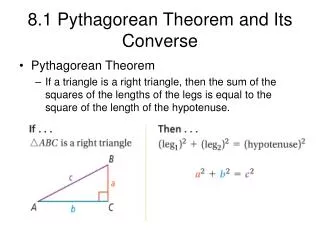
The Pythagorean Theorem If a triangle is a right triangle with leg lengths of a and b and a hypotenuse of c, then . c, (hypotenuse) a, (leg) b, (leg)
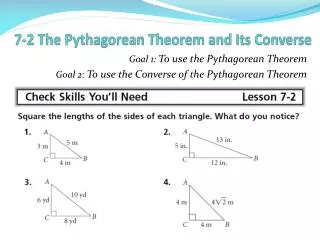
Examples: Solve for x. Round to the nearest hundredth if necessary. 16 ft m x 22 ft 12 ft 5 ft
Pythagorean Theorem Converse Given a triangle with leg lengths of a and b and a hypotenuse of c, if , then the triangle is a right triangle. Tell whether the triangle with the given side lengths is a right triangle. 15, 36, 39