Partial Pressures and Surface Equivalents
When diving, understanding the concept of partial pressures is crucial for safety. This guide explains that our bodies respond more to the partial pressure of gases than to their percentage in a gas mix. As divers descend or ascend, the changes in gas partial pressures can affect our physiology. We'll cover how to calculate the partial pressure of gases at given depths and derive surface equivalents, which help predict the effects of gas changes at various depths. Understanding these principles is vital for safe diving practices.

Partial Pressures and Surface Equivalents
E N D
Presentation Transcript
Why Do We Care? • Typically when diving we breathe a mixed gas. • Our body cares more about the partial pressure of a gas than about the % of the gas in the overall mix. • During descent or ascent, divers are affected by changes in the partial pressure of a gas. • To understand and predict the effect of these changes, think in terms of surface equivalents.
Objectives • Given the percentage of an individual gas within a mixed gas, correctly calculate the partial pressure of a gas, in atm. or psi, for a given depth. • Given the percentage of an individual gas within a gas mixture, and the depth at which it is being used, correctly calculate the surface equivalent.
Main Points • Definition of Partial Pressure • Calculating the partial pressure of a gas • Calculating surface equivalents
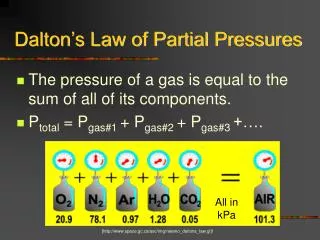
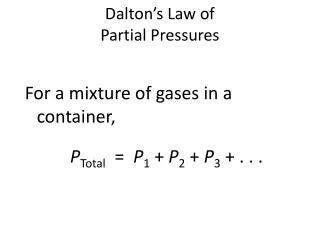
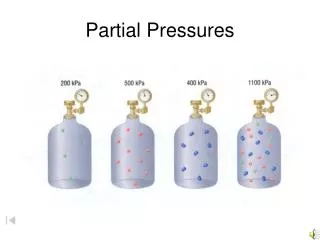
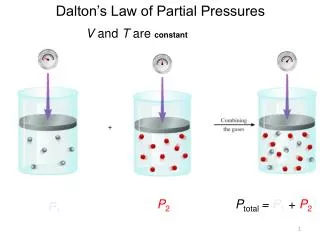
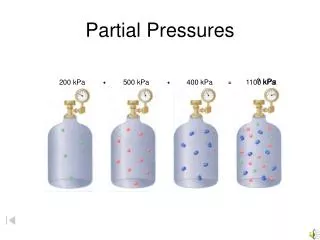
Partial Pressure • Pressure exerted by each individual gas within a mixed gas. • Expressed as PPg where g is the gas • Partial Pressure of Oxygen PP02 • Partial Pressure of Nitrogen PPN2
Calculating PPg Calculating PPg in atm.. Multiply %g in atm.. x total # atm.. Calculating PPg in psi Multiply PPg atm. x 14.7 psi
Calculating PP02 at depth Calculate PP02 in air at a depth of 66fsw Pressure atm.. = (depth + 33)/33 Pressure atm. = (66+33)/33 Pressure atm. = 3atm. PP02 atm. = 3atm.. X .2 =.6 atm.. PP02 psi = .6 atm. x 14.7 psi = 8.82 psi
Surface Equivalents • Breathing air at 297 feet of sea water (fsw) is the same as breathing what PP02 at sea level? % of 02 in air at any depth 20% Pressure in atms. @ 297 fsw (297' + 33‘)/33’ =10 atm PP02 in air at 297 fsw .2 x 10atm. =2atm
Surface Equivalents Breathing air with 2% C02 at 99' sea water, what is the surface equivalent? % C02 in this mix at any depth 2% or .02atm. Pressure in atms. @ 99 fsw (99' + 33‘)/33’ = 4atm. Surface Equivalent of 2% CO2 @ 99fsw .02 x 4atm. = 8% or .08 atm.
Have We Covered • Definition of Partial Pressure • Calculating the partial pressure of a gas • Calculating surface equivalents
Are you able to • Given the percentage of an individual gas within a mixed gas, correctly calculate the partial pressure of a gas, in atm. or psi, for a given depth. • Given the percentage of an individual gas within a gas mixture, and the depth at which it is being used, correctly calculate the surface equivalent.
Summary • Typically when diving we breathe a mixed gas. • Our body cares more about the pressure of the gas than about the % of the gas in the mix. • Even though the % of a gas does not change with depth, the partial pressure of the gas does change. • The effects of a gas are determined by the partial pressure of the gas and this explains phenomena such as ??????.