Understanding Feistel Cipher Structure in Symmetric Encryption
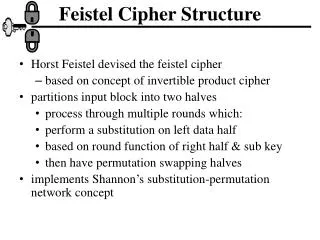
The Feistel cipher, introduced by Horst Feistel in 1973, serves as the foundation for many symmetric encryption algorithms like DES, IDEA, Blowfish, RC6, MARS, and Twofish, but not AES. It operates as a substitution-permutation network and represents a block cipher. Key features include block size, key size, the number of rounds, sub-key generation, and the round function. Notably, decryption mirrors encryption, utilizing sub-keys in reverse order. This model guarantees reversibility if we can reconstruct its inputs derived from the key.

Understanding Feistel Cipher Structure in Symmetric Encryption
E N D
Presentation Transcript
CS 465 Feistel Model Last Updated: Aug 27, 2013
Feistel Cipher Structure • Described by Horst Feistel (IBM) in 1973 • Many symmetric encryption algorithms use this structure • DES, IDEA, Blowfish, RC6, MARS, Twofish • Not AES • Substitution-permutation network • Block cipher • Features – block size, key size, number of rounds, sub-key generation algorithm, round function • Decryption is essentially the same as encryption • Input: ciphertext • Use sub-keys in reverse order • Sources • Stallings NSE Fig 2.2 (next slide) • Wikipedie: Feistel Cipher
The Feistel Network Round Function (F) • The Feistel network is guaranteed to be reversible if we can reconstruct its inputs, which are derived from the key • It doesn’t matter how complicated or simple F is or if it can be inverted
Proof of Feistel Network • On the board • What is the disadvantage of a 1-round Feistel network?