Download
1 / 6
60 likes | 182 Vues
Transcendentalism is an eclectic collection of ideas shaped by individuals like Emerson, Thoreau, and Fuller, questioning established norms in literature, philosophy, and culture. It emerges from a quarrel within the Unitarian church, emphasizing the mind's role in actively shaping experience over passive sensory perception. Key concepts include the unity of the individual soul with the universal Oversoul, human dignity, and the inherent goodness of nature. Although it lacked institutional permanence, Transcendentalism profoundly influenced American intellectualism, advocating for spiritual truths beyond sensory experience.

E N D
Definition?? • Defies definition! • A loose collection of eclectic ideas about literature, philosophy, religion, social reform, and the general state of American culture • had different meanings for each person involved in the movement
Okay, fine, try to define it…Martin Bickman, University of Coloradohttp://transcendentalism.tamu.edu/ideas/definitionbickman.html • “Beginning as a quarrel within the Unitarian church, Transcendentalism's questioning of established cultural forms, its urge to reintegrate spirit and matter, its desire to turn ideas into concrete action developed a momentum of its own, spreading from the spheres of religion and education to literature, philosophy, and social reform. While Transcendentalism's ambivalence about any communal effort that would compromise individual integrity prevented it from creating lasting institutions, it helped set the terms for being an intellectual in America.”
Which means what, really?Martin Bickman, University of Colorado • “Transcendentalism, then, is not as much concerned with a metaphysics that transcends our daily lives but rather with a new view of the mind that replaces Locke's empiricist [knowledge comes from sensory experience], materialistic, and passive model with one emphasizing the role of the mind itself in actively shaping experience.” • “The Transcendentalist vision [insisted] that the mind can apprehend absolute spiritual truths directly without having to go through the detour of the senses, without the dictates of past authorities and institutions, and without the plodding labor of [reasoning].”
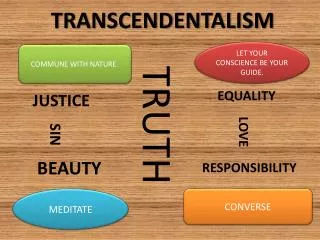
Characteristics • Microcosm/Macrocosm: “the soul of each individual is identical with the soul of the world and contains what the world contains;” applies to nature too • Universal soul/ “Oversoul:” shared universal soul – encompassing God, nature, and humanity • Natural goodness of humans: human dignity • Beauty manifests itself through something done right • Nature is essential to those who seek reality and the truth due to its beauty, perpetual wonder, and ‘soothing touch of the Over Soul. • Balance: btw evil and good, btw fate and free will
Major Players • Ralph Waldo Emerson • Henry David Thoreau • Margaret Fuller • Walt Whitman