PRESENT PERFECT TENSE
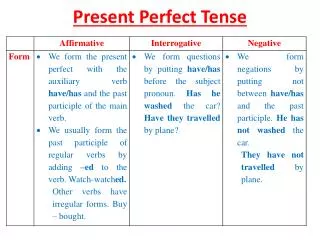
The Present Perfect Tense is essential for expressing finished actions linked to the present. It highlights how past events influence our current situation. For instance, saying "I have broken my leg" indicates a continued impact on the present, unlike the simple past form. This tense also conveys personal experiences without a specified time, often using "ever" and "never," as in "I have never been to Japan." Additionally, it describes actions that started in the past and continue now, utilizing time expressions like "for" and "since."


PRESENT PERFECT TENSE
E N D
Presentation Transcript
finishedeventsconnectedwiththepresent • Weusethepresentperfectespeciallyto say that a finishedactionoreventis connectedwiththepresent in someway. Ifwe say thatsomething has happened, wearethinkingaboutthepastandthepresent at thesame time. • I can'tgoon holidaybecause I havebrokenmyleg. (NOT I can'tgoon holidaybecause I brokemyleg.)
Wehavelived in thishouseforfiveyears. (= andwestilllivethere) • Yourplane has alreadylanded. (= andit’sstill on theground) • She has dirtied her newshoes. (= They’restilldirty) • Theteacher has writtena notice on the board. (= andthenotice is stillthere) • Youdon’tneedyourkey. I’veopenedthedoor. (= andit’sstillopen)
Present Perfect Tense Personal experiences: It is used to express personal experiences, there is not a definite time given.The time expressions ever and never are very often used with this meaning I have never been to Japan. Have you ever been there?
Present Perfect Tense It is used to express actions that started in the past and continue to the present, the time period is not finished. We use for and since with this meaning. We use for with periods of time and since with points of time. I haven’t eaten since yesterday morning. I am really hungry I haven’t drunk anything for two days. I am terribly thirsty