Absolute Age Dating
Absolute Age Dating. Absolute Age/Dating. the numeric age of an object or event Stated in years Variety of methods can be used. Methods of Absolute Age Dating. Rates of Erosion Rates of Deposition Varve Count Radiometric Dating Carbon Dating. Method 1: Rates of Erosion.

Absolute Age Dating
E N D
Presentation Transcript
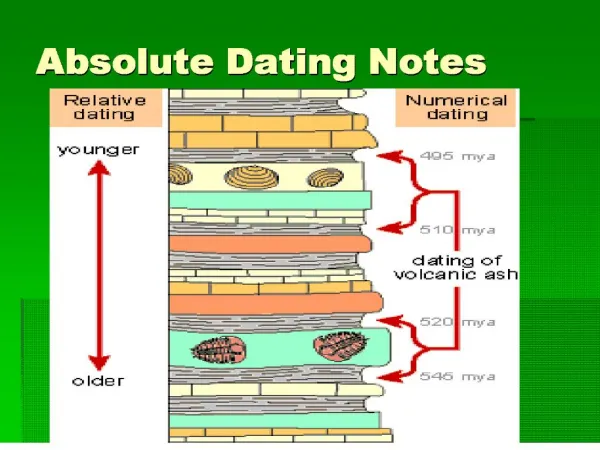
Absolute Age/Dating • the numeric age of an object or event • Stated in years • Variety of methods can be used
Methods of Absolute Age Dating • Rates of Erosion • Rates of Deposition • Varve Count • Radiometric Dating • Carbon Dating
Method 1: Rates of Erosion • Uses the rates at which geological features erode • Only practical for geological features that formed within the past 10,000-20,000 years. • Example: scientists can measure the rate at which a stream erodes in its bed to estimate the age of the stream.
Method 2: Rates of Deposition • Scientists use the rate at which sediment is deposited for common sedimentary rocks such as limestone, shale, and sandstone. • Generally, about 30cm of sedimentary rock are deposited over a period of 1,000 years. • Not always accurate—floods and erosion can affect the average rate.
Method 3: Varve Count • Varve-banded layer of sand & silt that is deposited annually in a lake • One varve represents one year of deposition • By counting the varves scientists can estimate the age of sediment
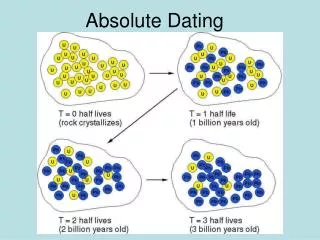
Method 4: Radiometric dating • Method of comparing the relative percentages of a radioactive (parent) isotope and a stable (daughter) isotope. • Radioactive isotopes have nuclei that emit particles & energy at a constant rate regardless of surrounding conditions.
Method 5: Carbon Dating • C14 dating/radiocarbon dating • Used to date younger rock layers by dating organic material found within the rock. • The ages of wood, bones, shells & other organic remains that are included in the layers & are less than 70,000 years old can be determined.