Ocean Biogeographic Information System
310 likes | 431 Vues
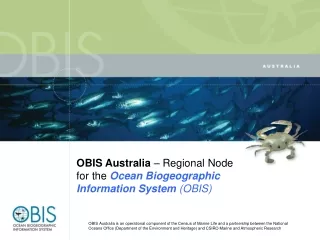
The Ocean Biogeographic Information System (OBIS), led by Edward Vanden Berghe, serves as a critical repository for primary data on marine species and their distributions. Accessible via www.iobis.org, OBIS allows users to explore data by taxa, time, and geographic location. It maps species distributions, supports the integration of diverse marine data, and enhances resource management by sharing standards and responsibilities. As a part of the Global Biodiversity Information Facility (GBIF), OBIS connects various marine datasets, ensuring data is preserved, accessible, and effectively utilized for research and conservation.


Ocean Biogeographic Information System
E N D
Presentation Transcript
Ocean Biogeographic Information System Edward Vanden Bergheevberghe@iobis.org
‘Mission’ • OBIS publishes primary data on marine species locations through www.iobis.org • It facilitates data discovery and exploration by • Searching by species, higher taxa, time, location, depth, database • Mapping, overlaying species distributions on ocean environment, modelling of potential environmental range • Integrates data over marine themes • Microbes to whales • Genetics and morphology • Poles to equator… • Enables data capture for re-use
Why do this? • Proper management of natural resources requires properly managed data and information • More data -> more knowledge • OBIS model makes data and information management more efficient • Share responsibilities, tools, standards… • Share data across different organisations and countries • OBIS is a way of ensuring data is not lost • Archaeology and rescue for historic data • Repositories for new data • Assist in data discovery • Links with EoL, BOLD…
OBIS in context • IT component of CoML • Capturing and integrating data • Support the 2010 synthesis • Marine component of GBIF • Fully inter-operable with GBIF standards • Extending with marine-specific elements • Marine component of Species 2000 • World register of Marine Species (WoRMS) • http://marinespecies.org • Partner with IOC, FAO, (UNEP) • Several OBIS Nodes are NODCs • FAO is large data provider and consumer
OBIS functions • Caches species distribution data from many databases • Creates taxonomic and geographic indices • Seeks out new datasets • Develops standards for data exchange and management • Develops software tools for online use • Makes all data freely accessible online
Predicting distribution of invasive species, Pterois volitans
Standards • Biogeography: GBIF/TDWG • Darwin Core, Extended to OBIS Schema • ABCD • Metadata: discovery metadata • Global Change Master Directory – NASA • MEDI – IODE; FGDC – US Gov? • Taxonomy: World Register of Marine Species (WoRMS) • Contribution to Species 2000, Catalogue of Life • Collaboration with ITIS • Geography • Polygon sets • EEZs, FAO areas, IHO… • Gazetteer
Standards: taxonomy • Aphia is general species register maintained at VLIZ • Consists of several overlapping subsets • defined geographical (ERMS, NWARMS…) • defined taxonomic (Porifera, Platyhelminthes…) • defined thematic (HABs, invasive species) • Exposed through www.marinespecies.org • WoRMS = Aphia + external GSDs • Algaebase, Hexacorallia, FishBase…
WoRMS plans • 100,000 valid species end 2007 • 2x0,000 valid species end 2008 • 85-90% of known species • Distribution records for all of these by 2010 • Many species only known from holotype!! • Management classification • Species 2000, ITIS • Gap analysis • Filling gaps in collaboration with ITIS
Standards: ‘OBIS Schema’ • Minimum data • Taxonomic name • Position: lat/long • Bookkeeping fields: unique ID, date last modified, collection name • Highly recommended • Date of observation • Depth • Taxonomic authority • Others • Date of identification, specimen accession number…
Standards: metadata • Global Change Master Directory • Separate portal • Enriched with information extracted from the database • Taxonomic, geographic scope • First/last observation • Map of distributions • Needs revision!
OBIS Nuts and Bolts • Distributed system • Making use of recent developments in technology (XML, DiGIR) • Web based • Three-tier system • OBIS provider installed at site of contributing database • Registry of providers • OBIS portal, which can be accessed by the end-users
DiGIR • Distributed Generic Information Retrieval • Semantics decoupled from protocol and software • Need to agree on a ‘federation schema’ • Defined as an XML schema • OBIS Schema, Darwin Core Schema (GBIF) • Specifies which data elements are exchanged, and how they are labeled • Data exchange and query formulation are XML files
OBIS number of records • 231 databases • In cache: • 13.6 million records, 147,000 names • In index: • 6.9 million records at genus level and below, 80,000 species • Among the largest provider to the Global Biodiversity Information Facility
Limitations of OBIS and OBIS data • We don’t know the total biodiversity • New species are discovered • Selective sampling in geography • Mostly in surface waters • Temperate zones • Selective sampling in taxonomy • Mostly big things, vertebrates
New species are discovered Data from http://marinespecies.org
Taxonomic bias Taxon # species # in OBIS % Cetaceans 133 117 88 Seals… 45 36 80 Fish 24139 21258 88 Echinoderms 6199 1624 26 Bryozoans 6000 1096 18 Decapods 8227 3796 46
Analysis of OBIS data • First attempts at diversity pattern on a global scale, with a large number of taxa • Previously either local or on one taxon (e.g. commercial large fish like tuna, forams…) • ‘Safety in numbers’ • Results not affected by idiosynchrasies of single taxon or study • Results very preliminary, and need data cleaning and further checking • E.g. by artificially removing datasets from analysis
Current priorities • Filling some of the gaps • In collaboration with existing RONs • By creating new RONs • Philippines, Oman • Completing the inventory of known marine species: WoRMS • Prioritise on having at least one distribution record per species, preferably the type locality • Creating an inventory of existing data • Also data not now available through OBIS • Importance of metadata
Plans for the future • More data and analysis • Develop thematic portals, on issues of direct societal relevance • Invasive species, HABs… • Develop demonstrator projects • Species distributions, hotspots… • Support CoML scientists • Integration across themes • 2010 Synthesis • Publications: theme section(s)