Download
1 / 14
140 likes | 334 Vues
In this part of our study on resistors and electricity, we delve into Ohm's Law, detailing how the current in a metallic conductor is directly proportional to the potential difference across it while maintaining constant temperature. We explore the behavior of filament lamps, where increased current leads to higher temperatures and resistance, thereby defying Ohm’s Law. Additionally, we introduce semiconductor diodes, highlighting their unique characteristics and applications like LEDs. Finally, we examine how the resistance of conductors is affected by their length and cross-sectional area, addressing the concept of resistivity.

E N D
Properties of Resistors Current of Electricity (Part 2)
Topics • Ohm’s Law • Ohmic Conductor • Filament Lamp • Semiconductor Diode • Resistivity
Previously from Part 1… • Definition of Resistance: ratio of potential difference to the Current • R = V/I • Note that this is the definition of resistance. This is always true, no matter what the values of V and I are. • We will now study something which is potentially confusing if you are not strong with this concept
Ohm’s Law • Ohm’s Law states that the current passing through a metallic conductor is directly proportional to the potential difference across it, provided that physical conditions (such as temperature) remains constant • Important note: Ohm’s Law only holds true if it is a metallic conductor AND temperature is constant
Ohmic Conductor Current P.D.
Filament Lamp Current P.D.
Filament Lamp • As current increases, the filament generates more heat, increasing the temperature • (Note: Ohm’s Law no longer applies when temperature increases) • When temperature increases, the resistance increases
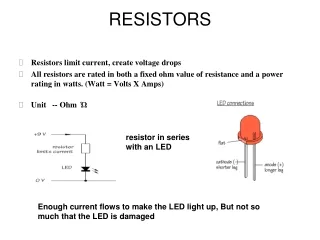
Semiconductor Diode • A semi-conductor is a non-metal, and it does not obey Ohm’s law • Some semiconductor diodes emit light, and they are called LEDs (Light Emitting Diodes) • LEDs are prevalent in technology, recently televisions also use LED technology • An ideal diode has zero resistance in one direction, but infinite resistance in the opposite direction
Ideal Diode Current P.D.
Real Life Diode Current P.D.
Semiconductor Diode • Diodes act has one-way only gates • They are extremely useful in electronics • We will come across diodes again when we study AC Electricity
Resistivity • This part of the lesson only concerns solid metal conductors • Two principles: • 1) The resistance of a conductor is directly proportional to its length • 2) The resistance of a conductor is inversely proportional to its cross-sectional area
Length Resistance R Length L Resistance 2R Length 2L
Cross-Sectional Area Cross-Sectional Area A Resistance R Cross-Sectional Area 2A Resistance R/2