Understanding Probability and Punnett Squares in Genetics
This resource explores the fundamentals of probability and its applications in genetics, particularly using Punnett squares. It begins with a basic overview of probability, illustrated with examples like coin flips. The principles of probability are then applied to genetic crosses, allowing for predictions about offspring traits. Punnett squares are introduced as a tool for visualizing possible genetic variations, distinguishing between homozygous and heterozygous organisms. The concepts of phenotype and genotype are clarified, highlighting the segregation ratios in offspring.

Understanding Probability and Punnett Squares in Genetics
E N D
Presentation Transcript
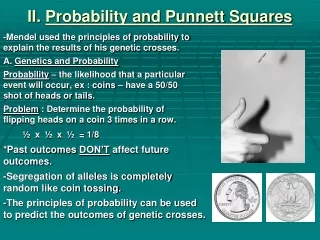
Probability • Probability is the likelihood that a particular event will occur. • For example: whenever you flip a coin, the probability of it landing heads up is ½ or 50% • If you were to flip it three times in a row, the probability of it landing heads every time would be: • ½ x ½ x ½ = 1/8 • Past outcomes do not affect future ones.
Genetics and Probability • The principles of probability can be used to predict the outcomes of genetic crosses • The probability of winning the lottery? • 80 million to one
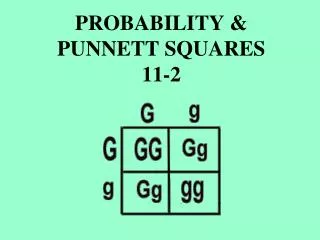
Punnett Squares • Punnett Squares can be used to predict and compare the genetic variations that will result from a cross.
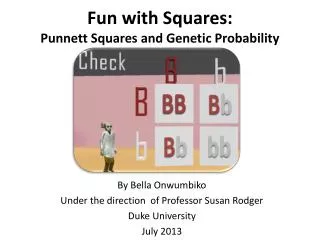
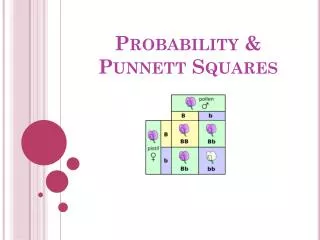
Punnett Squares • Gametes of F1 generation along top and left • Possible F2 generation offspring in squares of box • In this cross, B represents the dominant allele for blossom color
Punnett Squares • Organisms that have two identical alleles for a trait are said to homozygous (BB or bb) • These are true-breeding organisms • Organisms that have two different alleles for a trait are said to be heterozygous (Bb) • These are hybrid organisms
Phenotype/Genotype • Phenotype is the physical characteristics represented by a gene • Example: Purple blooms • Genotype is the genetic makeup • Example: BB or Bb are both genotypes for purple
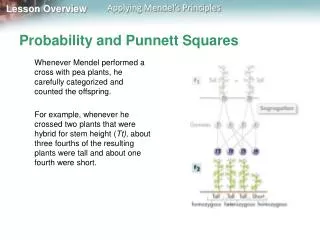
Probability and Segregation • ¼ of the plants have two alleles for purple blooms (BB) • 2/4 have one allele for purple and one for white (Bb) • ¼ have two alleles for white (bb) • Overall, there are ¾ with purple blooms. • Therefore, the ratio of purple to white blooms is 3:1. • Segregation occurred according to Mendel’s model