Download
1 / 5
50 likes | 188 Vues
This text explores the roles of producers, consumers, and decomposers in ecosystems. Producers, like plants and trees, use photosynthesis to create their own food from sunlight, forming the foundation of the food chain. Consumers, including herbivores, carnivores, and omnivores, obtain nutrients by eating other organisms. Scavengers, a type of carnivore, feed only on dead animals. Lastly, decomposers such as bacteria, fungi, and worms recycle organic matter back into the soil, enriching it for producers. This interconnected system is vital for ecosystem health.

E N D
Producers • Producers produce their own food through a process called photosynthesis. In this chemical reaction, sunlight helps make complex substances such as proteins and sugars. Example: Plants and trees
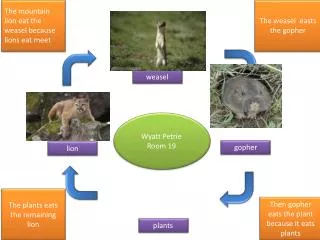
Consumers • Consumers are organisms that have to eat to obtain their nutrients. Herbivores- these eat plants Carnivores- these eat animals Omnivores- these eat plants and animals Carnivore Omnivore Herbivore
Scavengers • Scavengers are carnivores that only eat animals that are already dead. Scavengers usually wait until animals are done feeding, then they come in for leftovers. Hyena Vulture
Decomposers • Decomposers are nature’s recyclers. They help break down organic molecules into materials that go back into the soil to help fertilize the producers (plants). Bacteria Fungi Worms