Understanding Socialisation: Its Impact and Importance in Human Development
Socialisation is the vital process through which individuals learn to be human and integrate into society. It encompasses the acquisition of norms, values, and behaviors that govern social interactions. Primary socialisation begins at birth, primarily within the family, while secondary socialisation expands through educational institutions and other societal influences like media, religion, and workplaces. The concept of feral children highlights the necessity of socialisation for developing language, skills, and social understanding. Ultimately, society provides scripts regarding roles and behaviors, though individuals can choose how to interpret and engage with these scripts.

Understanding Socialisation: Its Impact and Importance in Human Development
E N D
Presentation Transcript
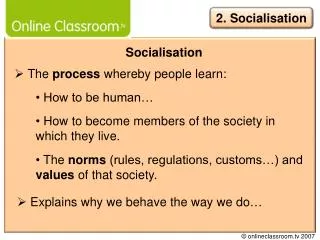
2. Socialisation Socialisation • The process whereby people learn: • How to be human… • How to become members of the society in which they live. • The norms (rules, regulations, customs…) and values of that society. • Explains why we behave the way we do… © onlineclassroom.tv 2007
2. Socialisation Feral Children • Children isolated from human contact from a very young age. • Illustrates importance of socialisation. • Unsocialisedchildren do not: • Develop human speech; • Understand language; • Walk on two legs; • Eat with tools (such as a knife and fork…). © onlineclassroom.tv 2007
2. Socialisation • Primary Socialisation - begins from the moment we’re born… • Close, personal and face-to-face interaction • Family is a major agency of primary socialisation: • Skills: How to walk, talk, use tools… • Norms: How to relate to family members. • Values: The difference between right and wrong behaviour. © onlineclassroom.tv 2007
2. Socialisation • Secondary Socialisation – learning to live in wider society… • School is an agency of secondary socialisation: • Introduces young people to: • Knowledge and skills; • Peer group interaction and relationships; • Relationships with non-family adults; • Authority and status differences. © onlineclassroom.tv 2007
2. Socialisation • Other agencies of secondary socialisation: • The Media. • The Workplace. • Religion. • Provide us with things like: • Moral instruction. • Role models. © onlineclassroom.tv 2007
2. Socialisation Scripting • Societies give people scripts to follow. • Like actors on a stage, people given scripts for: • Gender. • Nationality. • Class. • Age. • Ethnicity. We are socialised into the appropriate norms and values for these statuses. © onlineclassroom.tv 2007
2. Socialisation Choice • Easy to exaggerate role of socialisation. • Like actors we can: • Interpretthe scripts we’re given in our own way. • Change our scripts. • Refuse to follow them. • Tear them up and walk away. © onlineclassroom.tv 2007