Download
1 / 8
80 likes | 211 Vues
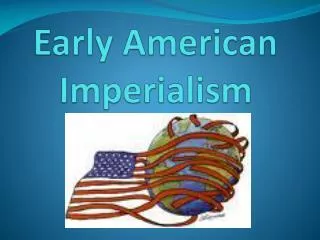
Early American Imperialism was the policy by which stronger nations exerted control over weaker nations through economic, political, or military means. Fueled by the concept of Manifest Destiny, the need for national security, and the search for new markets, such as in China, the U.S. expanded significantly during the 19th century. George Washington's Farewell Address warned against military alliances and advocated for isolationism. Key events include the annexation of Texas, the Oregon boundary dispute, and territorial gains from the Mexican-American War facilitated by President James K. Polk.

E N D
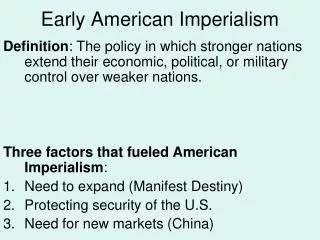
Early American Imperialism Definition: The policy in which stronger nations extend their economic, political, or military control over weaker nations. Three factors that fueled American Imperialism: • Need to expand (Manifest Destiny) • Protecting security of the U.S. • Need for new markets (China)
GW’s Farewell Address: 1. No military alliances with Europe, no standing army in peacetime2. Isolationism, focus on improving from within
Doubled the size of the U.S. • Lewis & Clark explored/claimed land to the Pacific Coast
Special Notice:“All guests are welcome, but they must not bring their guns.” 1820 The U.S. safeguards the Americas from European “predators”
Manifest Destiny: The belief that the U.S. had a natural right to expand across the continent. Texas won its independence from MX in 1835 behind Gen. Sam Houston. Many Texans and Americans desired annexation.
In addition to settling a boundary dispute over Oregon with Great Britain (“54°40’ or Fight!”), President James K. Polk (1845-1849) added Texas and the Mexican Cession (all or part of CA, NV, UT, CO, WY, NM, and AZ) after the ratification of the Treaty of Guadalupe-Hidalgo.
European New Imperialism had taken off during the nineteenth century.