Download
1 / 32
320 likes | 441 Vues
This educational resource delves into the fundamental characteristics that define living organisms, including their ability to grow, reproduce, and respond to their environment. Key concepts explored include the requirements for life, such as water and nutrients, and the role of sunlight in growth. The material also highlights experimental design principles, such as control groups and variables, to enhance understanding of scientific methods. Through engaging examples and questions, learners will deepen their grasp of biology and experimental science.

E N D
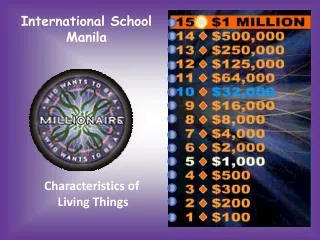
International School Manila Characteristics of Living Things
#1 Fire is not alive because… It is not made up of cells Can move A: B: Can grow Can Reproduce C: D:
#2 There a 3 conditions needed for life. Water, nutrients , and ____________. The Sun Glucose A: B: Energy Food C: D:
#3 Which of the following is NOT a characteristic of living things? Adapts to its environment Responds to its environment A: B: Reproduces Tastes good C: D:
#4 Mystery Matter was… A protist Yeast A: B: What’s Mystery Matter? Was not a living thing C: D:
#5 The Control Flask in The Mystery Matter Lab had glucose No water A: B: No glucose Salt C: D:
#6 In the Mystery Matter Lab Flask 4 should have inflated the most because It had the most glucose Had the most mystery matter A: B: Had the least amount of water Got the most sunlight C: D:
#7 We know Mystery Matter was alive because It bubbled and frothed The amount of glucose decreased A: B: The balloons on flasks 2,3, and 4 inflated All of the above C: D:
#8 The control group Is the group that changes Stays the same A: B: The group used as a basis for comparison Is not always needed in an experiment C: D:
#9 An example of responding to the environment is A turtle tucking into its shell Moving your hand away from a hot pan A: B: A plant growing towards the light All of the above C: D:
#10 3 variables needed in a experiment are… Independent, constant, variable Dependent, independent, constant A: B: Control, dependent, test group None of the above C: D:
#11 The Effect of Sunlight on the Growth of a Plant. An example of the dependent variable is Keeping a group of plants in the dark Changing the amount of sunlight A: B: Both A and B 25 cm C: D:
#12 A Constant Variable in the Mystery Matter Lab was The amount of Water The amount of yeast A: B: Both A and B Neither A and B C: D:
#13 What could be done to make the Mystery Matter Lab results more accurate? Add more glucose Add more mystery matter A: B: Add more water Get bigger balloons C: D:
#14 The independent variable is The results of the experiment The variable that is manipulated A: B: The variable that is tested against the control group The variable that stays the same C: D:
#15 Yeast is an example of ___________ A protist A bacteria A: B: A fungi Virus C: D:
Great Job!!!! Thank you for playing!