Essential Tips for Exam Preparation in Strategic Management
Preparing for your exam in strategic management can be challenging. These two slides will provide valuable guidance, whether you study alone or in a group. The first slide helps you outline key concepts for each school of strategy, including communication, culture, and leadership. The second slide allows you to organize your understanding by topic, such as design, planning, and positioning. Utilize examples from your readings and experiences to deepen your comprehension. This structured approach will enhance your preparation and boost your confidence ahead of the exam.

Essential Tips for Exam Preparation in Strategic Management
E N D
Presentation Transcript
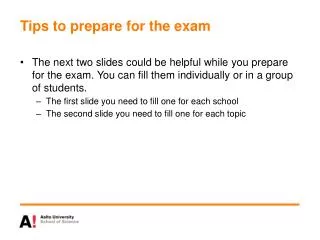
Tips to prepare for the exam • The next two slides could be helpful while you prepare for the exam. You can fill them individually or in a group of students. • The first slide you need to fill one for each school • The second slide you need to fill one for each topic
……………… School of Strategy (1 slide for each school) Main concepts Communication Structure Systems & Controls Culture Change & Leadership Premises Plan Pattern Position Perspective Ploy • Design • Planning • Positioning • Entrepreneurial • Cognitive • Learning • Political • Cultural • Environmental • Configuration Critique (both positive and negative) Examples in the text Other examples (based on articles read or professional experience) Chapter 1 Chapter 12 First pages of the chapter
……………… Topic (1 slide for each topic) • Design • Planning • Positioning • Entrepreneurial • Cognitive • Learning • Political • Cultural • Environmental • Configuration Main concepts / elements Plan: Pattern: Position: Perspective: Ploy Other examples (based on articles read or professional experience)
Topics in strategyimplementation(one for eachclass) Communication Structure Systems and Controls Culture Strategic Change & Leadership
The 10 School of Strategy Prescriptive • A DESIGN • (Design) 2. A PLAN (Planning) 4. A VISION (Entrepreneurial) 3. A POSITION (Positioning) 6. A PATTERN (Learning) 5. A PERCEPTION (Cognitive) 7. AN AGENDA (Power) 8. A BELIEF (Cultural) 10. A STAGE (Configuration) 9. A RESPONSE (Environmental) Descriptive Synthesis
A. Communication E. Strategic Change 9. A RESPONSE • A DESIGN 5. A PERCEPTION 3. A POSITION 4. A VISION E. Leadership 2. A PLAN 10. A STAGE C. B. 6. A PATTERN D. Culture 8. A BELIEF 7. AN AGENDA