Download
1 / 131
1.31k likes | 1.43k Vues
The ACCET Accreditation Workshop conducted on January 6, 2014, provided comprehensive insights into the accreditation process. This guide includes critical aspects of the accreditation framework, such as mission statements, financial procedures, and curriculum revisions. It outlines the timeline for site visits, financial requirements, and the structure of the Analytic Self-Evaluation Report (ASER). Participants can find valuable resources to enhance their understanding of institutional governance, program evaluation, and student services, alongside an essential checklist for successful on-site visits.

E N D
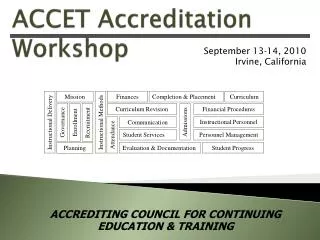
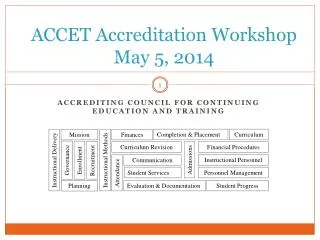
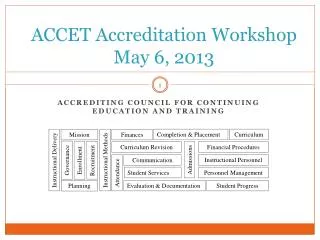
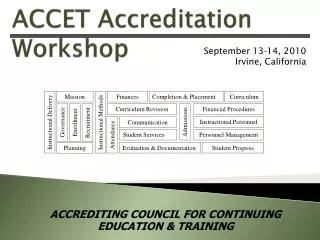
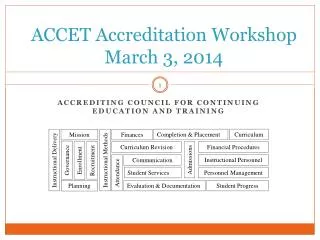
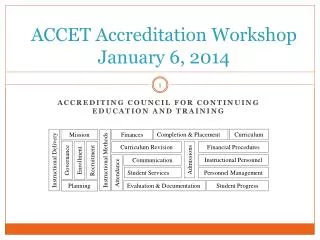
ACCET Accreditation WorkshopJanuary 6, 2014 ACCREDITING Council for Continuing Education and Training Completion & Placement Curriculum Mission Finances Curriculum Revision Financial Procedures Admissions Instructional Personnel Instructional Delivery Instructional Methods Communication Recruitment Governance Enrollment Student Services Personnel Management Attendance Planning Evaluation & Documentation Student Progress
Accreditation Process/Timeframe(Approximately 12 months) • On-site team visit & Team Report (2-day visit & Team Report sent within 30 days of visit) • Institution’s response to Team Report (due within 14 days) • Accrediting Commission’s review and decision • Commission letter (within 30 days of Commission Meeting
Fees • Reaccreditation Application Fee $1000 • Avocational Reaccreditation Visit Fee $3400 • Penalties for late reporting and late payments • See Document 10 for full fee schedule
Application for Accreditation Document 4
Overview of Analytic Self-Evaluation Report (ASER) Documents: 3.1, 3.2, 3.3, 3.2/3ESL (Combined) Overlay Templates: 3.ESL, 3.VESL, 3.IDL, 3.OAD, 3.MT, 3.NAH
Developing the ASER • Obtain support at the highest level • Commit resources • Start early • Assign a champion
Developing the ASER • Involve the entire staff • Conduct regular meetings • Develop/implement new policies and procedures, as needed • Tell the “story” of your institution
Developing the ASER • Use the current and appropriate ACCET Document 3 • Gather supporting documentation • Develop the ASER • EDIT, EDIT, EDIT
Structure of Your ASER Narrative • Written narrative addressing the eight standards (33 subsections) • Standards that do not apply • Documents supplementing narrative response to questions and requirements • Types of exhibits • Representative sample • Linked in ASER/BASER narrative
Any Additional Sites • Must be referenced in: • The application (Document 4) • ASER/BASER
Submission to ACCET • Submit the ASER using ACCET’s Accreditation Management System (AMS) by the scheduled due date. • The on-site visit fees using the electronic Check in AMS. • Completed Document 8 Form. (On Site Visit Request)
Need Help…. • Call ACCET for assistance: • Our staff is here to help you. • Never hesitate to call with any questions, concerns, or for guidance.
On-Site Review • Team composition: • Management Specialist/Chair • Commission Representative
On-Site Review Team Selection • No conflict real or perceived • Approved by institution • All materials confidential
Visit Materials • To be sent electronically by ACCET before the visit: • Confirmation letter • Checklist of materials to be available for team • Memorandum for on-site team visit • Team member roster • Letter of invitation sent to state licensing agency
Team Member Responsibilities • Prior to the Visit: • Review ACCET Documents • Study ASER • Identify issues for Clarification
Team Member Responsibilities • During the Visit: • Validate ASER representations • Observe, interview, collect data/documentation • Confer in team meetings • Summarize pertinent facts • Discuss/propose ratings, strengths, weaknesses • Write assigned standards for Team Report
Preparation for the Visit • Provide for the Team: • Private room/space for the team • Access to the internet - either WiFi or Ethernet cables • Documents requested on the Preparation Checklist • Any changes since the submittal of ASER • Current organizational chart
Preparation Checklist for ACCET On-Site Examination Visit • A complete paper copy of the institution’s eASER/BASER, including all exhibits • A completed copy of the program chart listing all approved programs and enrollment/staffing information (see www.accet.org/Documents and Forms/Fillable Documents) • A complete roster of all active students, including start dates, and a listing of students on LOA • A listing of all students who graduated, withdrew, or were terminated within the past 12 months • List of all students by name, program title, certificate/license sought, and date of graduation who were eligible for, attempted, or attained certification/licensure within the past 12 months (Vocational) • A current organizational chart with names and job titles • An updated staff turnover listing and calculated rates (separately for full/part time) since the submission of the eASER/BASER • Schedules for all faculty and administrative staff during the visit, including room locations, break times, office/teaching hours, and courses/classes being taught • Correspondence files of all communications with ACCET, state and federal agencies • Administrative operations/procedures manual. if not included in its entirety in the eASER/BASER
Preparation Checklist for ACCET On-Site Examination Visit • Personnel policies/employee handbook, if not included in its entirety in the eASER/BASER • A listing of who is responsible for and the location of personnel records for all employees, including any new or updated resumes or ACCET Document 6s - Personnel Form, job descriptions, and performance evaluations • Minutes of all staff and faculty meetings for the past 12 months • Completed ACCET Document 50FR – On-site Examination Team Financial Review Checklist. • ACCET Document 50I – On-site Immigration Compliance Checklist/Guidelines to be completed by the team. (Institutions authorized to enroll F1/M1 visa students) • State-licensing agency's cancellation and refund policy (if applicable) • Complete sets of curricular materials, including syllabi, lesson plans/instructor guides, testing and evaluation tools, text materials, and student performance standards • Current school catalog and completed ACCET Document 29 - Catalog Guidelines and Checklist(Vocational)
Preparation Checklist for ACCET On-Site Examination Visit • Current enrollment agreement and completed ACCET Document 29.2 - Enrollment Agreement Checklist(Vocational). NOTE: Avocational institutions must provide only a copy of their enrollment agreement/student application • Sample entrance examinations/criteria/test scores used to accept students (i) with a high school diploma/GED and/or (ii) who are admitted on a designated ability-to-benefit admissions basis • Samples of all advertising/promotional materials used by the school at any time during the past 12 months • Most recent fire and safety inspection certificates • Completed year-to-date ACCET Document 28.1 - Completion and Placement Statistics for each program (Vocational) • Names and email addresses of current students, graduates in the last 12 months, and 10 employers. • ACCET Document 12 – Annual Report and Enrollment Statistics completed for your institution’s most recent fiscal year ending. (Initial applicants)
The Visit • Introductory meeting • Tour of facility • Information gathering process • Exit briefing
Team Report • Consensus document • Draft report reviewed and verified by Team Chair • Team Report sent electronically to institution within 30 days of visit
Team ReportACCET Rating Scale • 4 – Exceeds standard • 3 - Acceptable and meets standard • 2 - Weak, some changes needed to meet standard • 1 - Unacceptable, major changes needed to meet standard
Responding to Weaknesses • Submit response within 14 calendar days of receipt of Team Report. • Respond in response boxes embedded in Team Report. • Prepare response with the same thought and thoroughness as ASER/BASER. • Address any weakness cited in Team Report and referenced to a specific standard.
Responding to Weaknesses • Link and clearly reference the exhibits that support response. • Ensure that response clearly reflects understanding of : • Cited weakness(es), • Corrective action taken, and • Evidence that corrective actions were systematically and effectively implemented.
Commission Meeting • Possible Commission Actions: • Accredit/Approve • Defer • Deny • Consensus Process • Written notification sent electronically (within 30 days of Commission Meeting) • Official Commission’s actions not revealed, prior to Commission letters being sent
AMS DATABASE DEMONSTRATION CONTINUED For AMS Support Contact: Meagan Paulk (mpaulk@accet.org) Grace Kye (gkye@accet.org)
ACCET Accreditation Standards • Mission • Management • Finances • Curricula • Instructional Delivery • Instructional Personnel • Admissions and Student Services • Evaluation
Standard I Mission
Standard I - Mission A. Mission Statement: • The institution clearly states its mission and makes it public. The mission is consistent with the Principles of Ethics for ACCET institutions; thereby providing a definitive basis upon which to deliver and assess the education and training programs. • The education and training provided are consistent with the institution’s mission and are documented by either a needs assessment or market experience
Consider this… • A Mission Statement communicates the institution’s purpose and objectives. • The mission contains your school's "winning idea" - separates you from your competitors. • Is the institution meeting its mission? What criteria is used to measure success?
Consider this… • How do you measure and verify that training is consistent with: • your stated mission; and • needs assessment or market experience. • The mission is refined to create a concise and precise statement which expresses your • purpose, • measurements of success, • results
Standard I - Mission B. Goals: • Broad institutional goals are clearly stated, support the mission, and are understood at all levels of the organization.
Key Points… • Goals must be: • Tied to the mission. • Understood at all levels of the institution. • Re-evaluated periodically to ensure relevance to the institution’s mission.
Examples of Institutional Goals • To provide programs of study that are educationally sound, up-to-date, of high quality and demonstrably effective. • To maintain a clear and consistent admissions process that accurately represents the program and the institution while producing enough enrollments to sustain the institutions. • To provide effective student services that recognize individual differences and to ensure successful student retention, graduation, and employability where applicable.
Examples of Institutional Goals • To establish and maintain employer relationships to ensure industry contacts necessary for student success. • To demonstrate the effectiveness of private educational training, thereby providing essential skills to support a productive workforce. • To ensure proper and ethical administration of all financial aspects of the institution.
Standard I - Mission C. Planning: • The institution has sound, written one-year and longer-range plans that encompass both the educational and business objectives of the institution. • The plans support the mission, facilitate the accomplishment of the broad institutional goals, and are updated at least annually.
Standard I - Mission C. Planning: • The plans include specific and measurable objectives, with corresponding operational strategies, projected time frames, required resources, and method(s) for subsequent evaluation of each objective.
A Business Plan Is NOT… • Only a budget • A market research report/analysis • A to-do list or wish list
A Business Plan … • Supports the Mission • Relates to Institutional Objectives • Facilitates your ability to provide quality training • Addresses various aspects of school operations
A Business Plan Is… • S - Specific • M - Measurable • A - Attainable • R - Resources Allocated • T - Time Based • E - Evaluated • R - Revised
S - SPECIFIC • Which of these is specific? • Raise the profile of the school • Improve marketing literature • Enhance curriculum • Provide catalog in Spanish • Increase gross revenue by 10%
M – MEASURABLE • Which of these are measurable? • Diversify the student body • Enhance student services • Increase enrollment in each program by 10% • Obtain student feedback
A - ATTAINABLE • Which of these is attainable? • Double enrollment next term • Increase applications by 4 per week • Build new building to house all school functions • 100% student satisfaction
R – RESOURCES ALLOCATED • Financial • Personnel • Equipment • Materials • Who is responsible?
T – TIME BASED • Which of these is time based? • Open a new branch • Offer internet based student evaluations by December 2012 • Increase revenue by 10% in 2012 • Expand web activity