Download
1 / 1
10 likes | 121 Vues
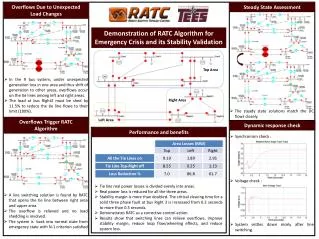
This study evaluates overflow situations in a 9-bus power system under unexpected load changes. When generation loss occurs, tie lines face overflows due to shifted generation. The Right2 bus requires an 11.5% load reduction to manage flows. The RATC (Real-time Adaptive Tie-line Control) algorithm is demonstrated as an effective corrective action, improving stability margins and enabling a significant increase in critical clearing time post-fault. It offers solutions that relieve overflows, enhance system stability, and return the system to normal operation without load shedding.

E N D
Overflows Due to Unexpected Load Changes Steady State Assessment Demonstration of RATC Algorithm for Emergency Crisis and its Stability Validation Top Area • In the 9 bus system, under unexpected generation loss in one area and thus shift of generation to other areas, overflows occur on the tie lines among left and right areas. • The load at bus Right2 must be shed by 11.5% to reduce the tie line flows to their limit (100%). Right Area • The steady state solutions match the DC flows closely. Overflows Trigger RATC Algorithm Left Area Dynamic response check Performance and benefits • Synchronism check : • Voltage check : • Tie line real power losses is divided evenly into areas. • Real power loss is reduced for all the three areas. • Stability margin is more than doubled. The critical clearing time for a solid three phase fault at bus Right 3 is increased from 0.2 seconds to more than 0.5 seconds. • Demonstrates RATC as a corrective control action. • Results show that switching lines can relieve overflows, improve stability margin, reduce loop flow/wheeling effects, and reduce system loss. • A line switching solution is found by RATC that opens the tie line between right area and upper area. • The overflow is relieved and no load shedding is involved. • The system is back into normal state from emergency state with N-1 criterion satisfied. • System settles down nicely after line switching.