
The Cell Membrane
E N D
Presentation Transcript
The Cell Membrane Mader Biology, Chapter 5
The Membrane is Selectively Permeable • The ability to allow some substances to cross more easily than others • Allows the cell to maintain an internal environment different from the external one
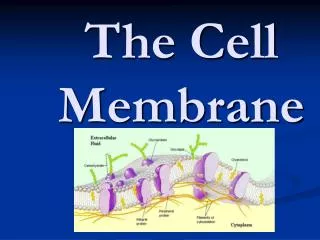
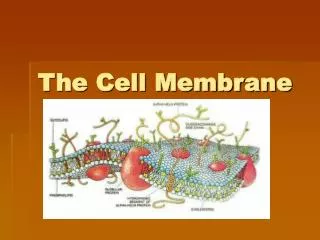
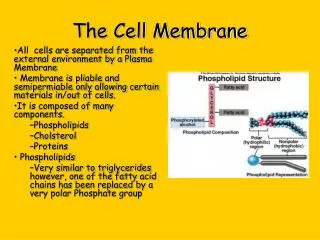
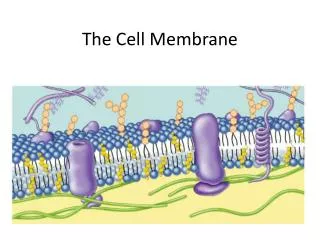
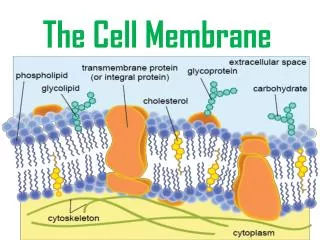
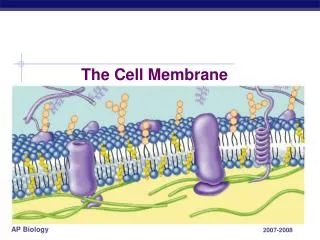
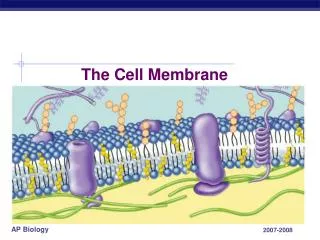
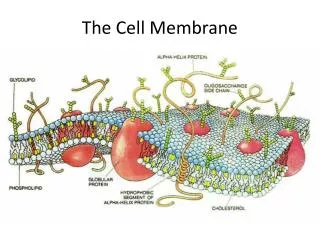
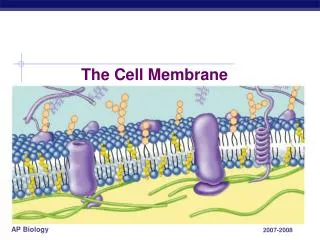
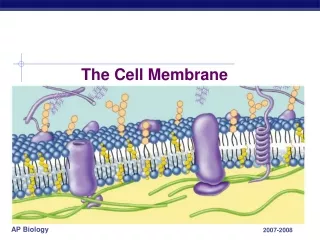
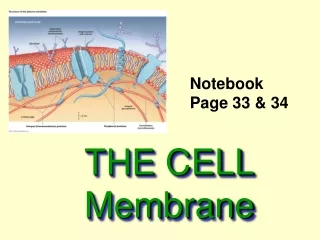
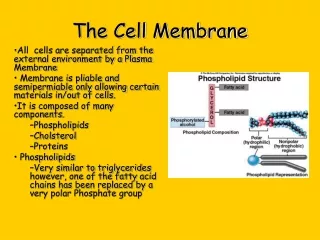
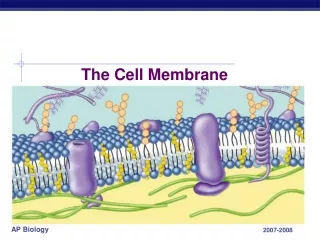
Membrane Components • Phospholipids Proteins • Cholesterol Carbohydrates (glucose)
Cholesterol • Steroid (lipid) found within the phospholipid bilayer • Keeps membrane solid when under heat
Membrane Proteins • Transport Proteins carry materials across the membrane
Glycocalyx Polysaccharides (chains of glucose) attached to glycoproteins Functions:
Modes of Membrane Transport • Passive Transport • Diffusion • Osmosis • Facilitated Diffusion • Active Transport • Protein Pumps • Endocytosis • Exocytosis
Passive Transport Goes “with” the concentration gradient; no ATP energy required
Simple Diffusion • The tendency for molecules of any substance to spread out into the available space • Molecules move from a region of high concentration to low concentration • moving down the concentration gradient
Osmosis • Osmosis is the diffusion of water across a semi-permeable membrane • Water travels • through protein • pores called • aquaporins
Effects of Tonicity on Cell Membranes • Hypotonic solution • higher concentration of water outside of cell results in hemolysis • Hypertonic solution • lower concentration of water outside of cell causes crenation • Isotonic solution • water concentration the same inside & outside of cell results in no net movement of water across cell membrane
Osmosis • Water always moves from a hypotonic solution to a hypertonic solution • What happens to cells when placed in: • Hypotonic solutions? • Hypertonic solutions? • Isotonic solutions?
Cells in Solutions Isotonic Solution Hypotonic Solution Hypertonic Solution No net movement of H2O (equal amounts entering & leaving) CYTOLYSIS PLASMOLYSIS
Facilitated Diffusion • Diffusion with the assistance of integral transport proteins. (Still Passive transport) Note: Carrier proteins allow both passive and active transport
Facilitated Diffusion • Transport proteins • Provide corridors allowing a specific molecule or ion to cross membrane • Undergo a shape change that translocates the molecule across the membrane • Still Passive Transport • Process requires no energy • Particles are moving from an area of high concentration to low concentration
Channel Proteins • Channel Proteins – allow certain materials to flow in and out (down their concentration gradient.) • Aquaporin – channel protein that only lets water in. • Ion Channels – also called gated channels, open and close in response to a chemical or electrical stimulus
Carrier Proteins • Carrier Proteins – change shape to escort certain material in and out of the cell. (Passive- down their concentration gradients; Active- against). Passive is shown below. How do you know?
Active Transport Goes “against” the concentration gradient (“low to high”); requires ATP energy
Active Transport • Movement of solutes AGAINST the concentration gradient. Goes from low to high concentration. • Requires energy input by the cell • ATP supplies this energy
Active Transport • Carrier proteins are needed to transport molecules across the membrane against the concentration gradient and require an expenditure of energy • Often referred to as “pumps”. • Ex: Na+ and K+ for nerve (neuron) impulses
Active Transport • Active transport - requires energy • Proteins act as pumps to move material from low to high concentration. Ex. Proton Pumps (Hydrogen Pumps) going against the gradient
Moving Large Objects • Endocytosis – Cells take in materials by forming vesicles from the plasma membrane • Exocytosis – Cell secretes macromolecules by the fusion of vesicles with plasma membrane
2 Types of Endocytosis • 1. Phagocytosis: engulfing solid particles • 2. Pinocytosis: engulfing liquid substances (extracellular fluid)