Download
1 / 37
370 likes | 534 Vues
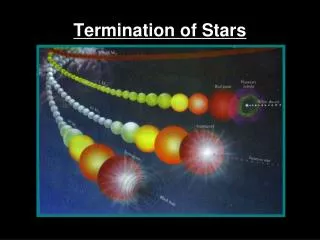
The universe orchestrates an intricate ballet of matter and energy governed by fundamental principles such as the Pauli Exclusion Principle and Heisenberg Uncertainty Principle. As stars exhaust their nuclear fuel, they face the degeneracy pressures of electrons and neutrons, leading to the formation of white dwarfs and neutron stars, or even black holes. This article examines the life cycles of stars, the explosive phenomena of supernovae, and the resulting cosmic remnants, detailing how these processes shape our universe and our understanding of its fundamental laws.

E N D
Pauli Exclusion Principle: Effectively limits the amount of certain kinds of stuff that can be crammed into a given space (particles with “personal space”). When densities approach this limit, matter becomes “degenerate”. Gas pressure depends on density only, and not temperature. Heisenberg Uncertainty Principle: Cannot simultaneously know both particle position and momentum exactly. Particles can have large speeds when densely packed, and so high pressure, regardless of temperature. Some Quantum Concepts
Wave-Particle Duality:The Two-Slit Experiments Particles - Mud stripes Waves - fringe pattern Electrons - both!!!
Electron Degeneracy: Atoms are crammed. Occurs at r~106 g/cm3. White Dwarf stars halt collapse via this pressure. Neutron Degeneracy: If gravity is too strong, electrons forced into nucleus with protons to make neutrons. Now nuclei are crammed. Occurs at r~1015 g/cm3! This pressure supports Neutron stars. Types of Degeneracy
Stellar Corpses – Low Mass Stars Stars with M < 8Mo become White Dwarfs (WDs) • Chandrasekhar Limit: MWD < 1.4Mo, otherwise gravity overwhelms electron degeneracy pressure • For normal stars, bigger M yields bigger R, but opposite for WDs • Radius is fixed, and WD still glows, so it just continues to cool and fade (i.e., temperature drops over time)
Supernova Types • Type Ia • Lacks hydrogen • Consists of a WD in a binary with mass transfer • Used as standard candle • Type II • Shows hydrogen • Explosion of a single massive star
WDs in Binaries • Mass can transfer from a normal star to a WD, resulting in an accretion disk. • This is a disk of gas orbiting the WD with gas slowly “seeping” inward to the WD. • NOVAE: Hydrogen gas accumulates and heats up until fusion switches on. Leads to an explosion and ejection of mass. Repeats. • SUPERNOVAE: (Type Ia) Transfer is rapid so fusion is ongoing. Mass accumulates until Chandra limit is exceeded which leads to a catastrophic explosion. SNe can become brighter than a galaxy for a time.
Sketch of a Cataclysmic Variable Example Nova lightcurve
Stellar Corpses – High Mass Stars If 8 Mo < M < 25 Mo, stars explode as Type II SNe • Nuclear fusion of elements up to iron • Central core becomes a WD, then a NS. Gravitational contraction is resisted, and a violent “shudder” lifts outer gas layers • LOTS of neutrinos made to accelerate material away • A NS remains, with • R ~ 10-15 km • M ~ 1.5-3 Mo • Fast rotation and strong magnetic fields
Historical Supernovae • 1967, first Pulsar was discovered • These are fast rotating NS’s that beam radiation out (nearly) along the magnetic poles • The effect is like a lighthouse Beacon
Mass-Radius for Neutron Stars • Right shows a mass-radius relation for neutron stars. • Curves are for different models • Frequencies relate to rotation periods and help to constrain neutron star sizes and structure. • Shaded regions of figure are observationally disallowed.
Stellar Corpses – Real High Mass • For M > 25Mo, stars also explode as Type II SNe, but the remnant mass exceeds the NS mass limit of ~ 3Mo Gravity wins! • Remnant collapses to a BLACK HOLE (BH) • A BH is an object with a sufficient concentration of mass that light cannot escape it. (Does not mean a BH is a cosmic “vacuum”.)
Schwarzschild Radius • Recall escape speed: • The Sch. Radius (RS) is the distance at which vesc=c for a BH: • Nothing travels faster than light, so anything passing closer than RS will not re-emerge!
How to Detect? • Although small and faint/invisible, NS’s and BHs do influence their surroundings • Can infer their presence in binaries from the motion of a visible star • Also, in binaries these compact objects can draw matter from the normal star to form an accretion disk, with associated X-ray emission • Some good examples are Cyg X-1 and A0620-00