Download
1 / 17
170 likes | 277 Vues
This article explores observations of aerosol size distribution through in situ measurements, focusing on factors affecting accuracy. It discusses sources of errors such as light source nature and particle properties. The study covers measurements spanning three decades, providing valuable insights for atmospheric science.

E N D
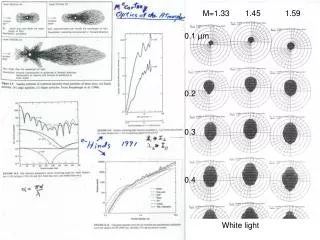
M=1.33 1.45 1.59 0.1 µm 0.2 0.3 0.4 White light
M=1.33 1.45 1.59 M=1.33 1.45 1.59 1.0 µm X=10 0.5 µm 0.6 0.7 0.8
Deshler, T., Observations for Chemistry (In Situ): Particles, article for Encyclopedia of Atmospheric Science, Academic Press, 2002.
Wyoming Optical Particle Counter, r > 0.2 - 10.0 m Aerosol in Optical Chamber Processor White light PHA PMTs Pump
Sources of Error • Size • Chromatic nature of light source • Aerosol index of refraction and shape • Uniformity of illumination • PMT response – pulse width broadening • Number concentration • Flow rate • Coincidence • Poisson counting uncertainty Deshler, T., M. E. Hervig, D. J. Hofmann, J. M. Rosen, and J. B. Liley, Thirty years of in situ stratospheric aerosol size distribution measurements from Laramie, Wyoming (41N), using balloon-borne instruments, J. Geophys. Res., 108(D5), 4167, doi:10.1029/2002JD002514, 2003
1971 - 1990 1990 - present Post El Chichon
Low Gain Mid Gain High Gain
Eidhammer, T., D. C. Montague, and T. Deshler, Determination of Index of Refraction and Size of Supermicrometer Particles from Light Scattering Measurements at Two Angles, J. Geophys. Res., in press, May 2007.
SAGE II HALOE
Comparison with SAGE II Extinction. Kovilakam and Deshler, 2014,
Comparison with HALOE Extinction. Kovilakam and Deshler, 2014,