Evaluation of Depth-Dependent Measurements in CIRS Phantoms Using Verasonics for Elastography
60 likes | 165 Vues
This study investigates the depth-dependent measurements of shear wave speed (SWS) in CIRS phantoms C4-2 and L7-4. Using Verasonics technology, SWS was evaluated at apertures of 32, 64, and 96 elements across five depths, with multiple readings taken to assess variability. Preliminary findings highlight challenges related to sound speed, attenuation, and uniformity control. Future enhancements in phantom design are proposed to improve measurement accuracy and address limitations observed in previous studies, emphasizing the significance of in vivo variations.


Evaluation of Depth-Dependent Measurements in CIRS Phantoms Using Verasonics for Elastography
E N D
Presentation Transcript
Depth Dependent Measurements Observed in Phantoms Shigao Chen 5/17/2013
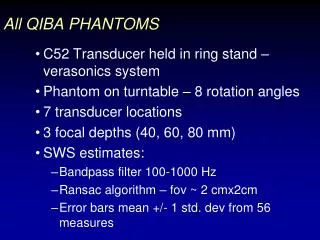
Three “homogeneous” CIRS phantoms C4-2 and L7-4 Aperture size: 32, 64, and 96 elements SWS measurements at 5 depths with Verasonics (4 kHz detection frame rate) Five readings at different spatial positions for each combination above MRE and Transient Elastography validation Previous Phantom Study Ultrasound in Med. & Bio. 37(11): 1884-1892, 2011
A homemade phantom: 10cm, depth 7.5cm Verasonics with C4-2 (QIBA phantom test code) SWS measurements at 3 and 4.5 cm Ten readings at different spatial positions Flip phantom upside down and repeat measurements Rough Preliminary Study
Results Limitations: phantom sound speed, attenuation, uniformity not controlled; one appraiser; gel coupling; probe compression not controlled: hard to catch a small depth effect (by chance?). CIRS will make a test phantom with double acoustic windows and water wells, with thickness of 10 cm so that depths at 3, 5, 7 cm are symmetric from both windows. Significance vs. in vivo variation (biological, technology, operator)