Download
1 / 9
90 likes | 193 Vues
This document outlines key steps in Air Quality (AQ) management following a systems approach. It emphasizes the setting of AQ goals, ongoing monitoring, assessment of trends, and taking actions to reduce exceedances. Each management module is clearly defined with specific information needs. The role of the AQ analyst is highlighted as essential in providing information to various modules. Furthermore, it discusses national and local AQ analysis and the importance of collaboration between analysts to enhance data sharing and decision-making processes within the broader context of the EPA’s framework.

E N D
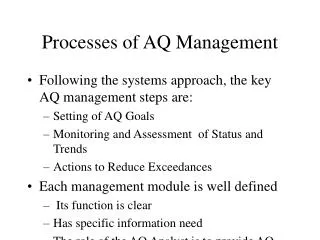
Processes of AQ Management • Following the systems approach, the key AQ management steps are: • Setting of AQ Goals • Monitoring and Assessment of Status and Trends • Actions to Reduce Exceedances • Each management module is well defined • Its function is clear • Has specific information need • The role of the AQ Analyst is to provide AQ information to these modules • These steps are consistent with the current EPA practice (?)
Processes, Participants and Methods of AQ Management • Table
Systems Concepts in Support of AQ Management Support • Provides an inclusive framework • Identify the key players/stakeholders and their relationship • Indicate their information needs and flow pattern
National and Local AQ Analysis • AQ data analysis needs to performed at both national (global) and local level • The ‘global’ analysis establishes the large scale context • Local analysis focuses on the specific and detailed local features • National-local interaction needs to be mutually beneficial
National-Local Information Sharing • The national and local analysts maintain their own ‘workspace’ • However, part of the workspace ( data, reports, some discussion) can be shared (exposed) • Networking can create a common virtual workspace
Potential Applications of National-Local Interaction • OAQPS-State Analyst • Supersite
PM Analysis Workbook in Support of SIPS • EPA's Emissions, Monitoring, and Analysis Division has initiating a collaborative effort to explore relevant analyses of the PM2.5 data to be collected by the new National and State monitoring networks . • The goals of the this collaboration are to foster an environment for the sharing of ideas and develop a workbook detailing useful analyses of the PM2.5 mass and speciated data. • The PM Analysis workbook will be used to deliver
PM Analysis Website • This website is a forum for the free exchange of fine particle data and information in support of these goals. • The virtual community that shares this website consists of individuals from the federal EPA, regional, state and local air pollution agencies, industry and other groups. To make a submission, find the appropriate section of the outline on the left. • Documents related to the official regulatory process are to be found on the companion EPA PM2.5 Data Analysis website.