
Relocalizing
E N D
Presentation Transcript
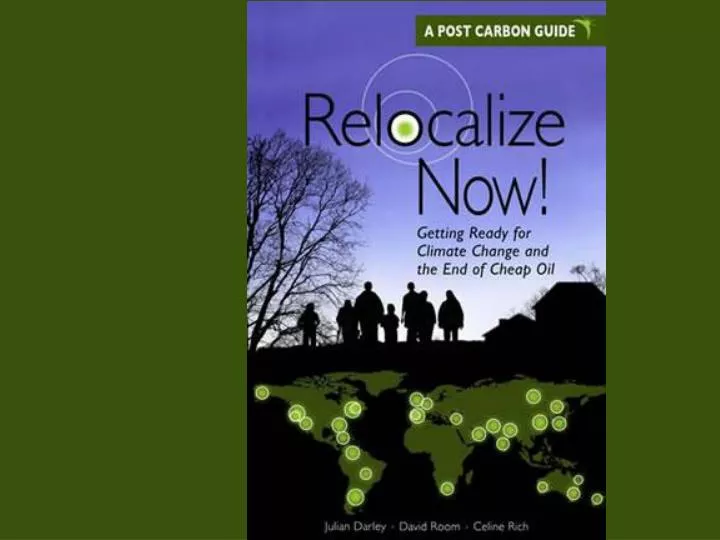
A POST CARBON GUIDERelocalize Now!Getting Ready for Climate Change and the End of Cheap Oilby Julian Darley, David Room, and Celine Rich New Society Publishers, Autumn 2005
A POST CARBON GUIDERelocalize Now!Getting Ready for Climate Change and the End of Cheap OilChapter 8Community Supported Manufacturing
Relocalizing • means a return to community self-reliance instead of corporate compliance and dependence;
Relocalizing • means a return to community self-reliance instead of corporate compliance and dependence; • has villages, towns, cities, counties, and regions see their purpose as provisioning themselves with their core needs for durable goods and food—
Relocalizing • means a return to community self-reliance instead of corporate compliance and dependence; • has villages, towns, cities, counties, and regions see their purpose as provisioning themselves with their core needs for durable goods and food— • and only then looking further afield for what cannot easily be produced locally.
Barriers to relocalizing • Loss of knowledge • Loss of infrastructure • Loss of tools
Barriers to relocalizing • Loss of knowledge • Loss of infrastructure • Loss of tools • in food production, as farming became the occupation of a minority;
Barriers to relocalizing • Loss of knowledge • Loss of infrastructure • Loss of tools • in food production, as farming became the occupation of a minority; • in manufacturingcapability, as globalization of production created specialized centers of manufacturing.
Parallel public infrastructure • Will come about in the effort to nearly totally remake the present infrastructure;
Parallel public infrastructure • Will come about in the effort to nearly totally remake the present infrastructure; • Will be a system to help integratethe many disparate efforts that are now starting to bridge the transition, the “carbon chasm;”
Parallel public infrastructure • Will come about in the effort to nearly totally remake the present infrastructure; • Will be a system to help integratethe many disparate efforts that are now starting to bridge the transition, the “carbon chasm;” • Will require training, analysis, knowledge, energy, and local currency;
Parallel public infrastructure • Will also require the active and prolonged financial support of the community, as in community supported agriculture (CSA);
Parallel public infrastructure • Will also require the active and prolonged financial support of the community, as in community supported agriculture (CSA); • Will encompass a mixture of ownership structures
Parallel public infrastructure • Will also require the active and prolonged financial support of the community, as in community supported agriculture (CSA); • Will encompass a mixture of ownership structures • from municipal ownership and operation • through cooperatives and mutual aid organizations • to family businesses and other smaller, locally owned firms.
Transition = Compromise • The transitions to a post-carbon world and low-impact human society will require compromise.
Transition = Compromise • The transitions to a post-carbon world and low-impact human society will require compromise • We don’t know how short nor how abrupt the transition, the “carbon chasm,” will be.
Transition = Compromise • The transitions to a post-carbon world and low-impact human society will require compromise • We don’t know how short nor how abrupt the transition, the “carbon chasm,” will be. • We shall assume a middle path regarding the transition — that it is painful but possible to “get off” big energy, particularly fossil fuels.
Transition = Compromise • We hope to avoid the most painful transition by thinking, planning, action.
Transition = Compromise • We hope to avoid the most painful transition by thinking, planning, action. • Since we are so over-populated and so dependent on external energy, we cannot humanely just stop using all external energy —
Transition = Compromise • We hope to avoid the most painful transition by thinking, planning, action. • Since we are so over-populated and so dependent on external energy, we cannot humanely just stop using all external energynor quickly reduce the amount of food that we are producing.
Transition = Compromise • We hope to avoid the most painful transition by thinking, planning, action. • Since we are so over-populated and so dependent on external energy, we cannot humanely just stop using all external energy nor quickly reduce the amount of food that we are producing. • We have to work out transition strategies that take clear account of our present position and population.
Transition = Compromise • We’ll need to continue some small-to-medium-scale mechanized production—
Transition = Compromise • We’ll need to continue some small-to-medium-scale mechanized production— • developing local manufacturing to produce and repair some of the necessities of life.
Transition = Compromise • We’ll need to continue some small-to-medium-scale mechanized production, • developing local manufacturing to produce and repair some of the necessities of life. • Relocalized manufacturing is then, from the outset, a compromise.
Transition = Compromise • We’ll need to continue some small-to-medium-scale mechanized production, • developing local manufacturing to produce and repair some of the necessities of life. • Relocalized manufacturing is then, from the outset, a compromise. • Medium-scale mechanical production will be needed until our population is at the earth’s carrying capacity.
Transition = Compromise • A practical transition strategy means community supported manufacturing,CSM, along with relocalized food production.
Transition = Compromise • A practical transition strategy means community supported manufacturing, CSM, along with relocalized food production. • Relocalizing production means a reversal of decades of global economic policy and the rebuildingof regional supply lines.
Transition = Compromise • A practical transition strategy means community supported manufacturing, CSM, along with relocalized food production. • Relocalizing production means a reversal of decades of global economic policy and the rebuildingof regional supply lines. • The details will be developed over time as we return to local self-reliance.
Community-supported manufacturing,CSM,will involve thinking about energy from start to finish, both practically and theoretically.
What should Community Supported Manufacturing concentrate on making? • We need to make what is necessary for our daily needs.
What should Community Supported Manufacturing concentrate on making? • We need to make what is necessary for our daily needs. • To identify what is necessary, imagine that your town is cut off for a week from outside communication, from outside energy . . . . .
The CSM essentials • Machines which harvest energy to make electricity;
The CSM essentials • Machines which harvest energy to make electricity; • Machines which store the harvested energy;
The CSM essentials • Machines which harvest energy to make electricity; • Machines which store the harvested energy; • Devices which warm water using direct solar rays;
The CSM essentials • Machines which harvest energy to make electricity; • Machines which store the harvested energy; • Devices which warm water using direct solar rays; • Ways to pipe and store water;
The CSM essentials • Machines which harvest energy to make electricity; • Machines which store the harvested energy; • Devices which warm water using direct solar rays; • Ways to pipe and store water; • Small, light electric vehicles;
The CSM essentials • Machines which harvest energy to make electricity; • Machines which store the harvested energy; • Devices which warm water using direct solar rays; • Ways to pipe and store water; • Small, light electric vehicles; • Tools for growing our own food and for other obvious local specialties that require tools.
The CSM workshops • Fabrication: making the things that last • Fire: high-temperature operations • Fibre: fabric, clothing, rope, paper • Food • Fuels and chemical reactions • Fixing: repairing and maintaining
The Fabrication Workshops: making the things that last • are where finished, durable goods will be designed, refined, machined, made, assembled and tested; • will need to start small and be carefully planned; • will be a source of apprenticeships and employment.
The Fabrication Workshops: making the things that last • will make devices for energy harvesting, including • small turbines for water or wind; • solar PV devices—although due to the complexity of manufacture, these devices won’t be among the first attempted. • will design energy storage, including • mill ponds; • batteries.
The Fabrication Workshops: making the things that last • will make devices for transport, including • small, light electric vehicles, which can be charged from our local energy harvesting devices, which do not depend on the main grid, and which use batteries; • metal-rail electric trams, which use electricity efficiently, and do not need batteries.
The Fabrication Workshops: making the things that last • Will make vital tools, including • small, mundane tools and furniture of wood and metal for daily use • devices to measure wind and rain • solar water heaters • solar ovens • equipment for producing biofuels, including biogas digesters • ground-source heat pumps for space heating
The Fabrication Workshops: making the things that last • Will provide the energy units for local energy banks which in turn will serve to back local currencies.
The Fire Workshops: high-temperature operations • match the right level of technology to the needs of a given a locale, • including use of used, slightly older, slightly simpler equipment.