Efficient Classification Using Feature Vectors
Learn about linear classifiers, feature values, weight vectors, and binary decision rules in classifying data efficiently. Explore perceptrons, multiclass classification, and strategies for successful training.

Efficient Classification Using Feature Vectors
E N D
Presentation Transcript
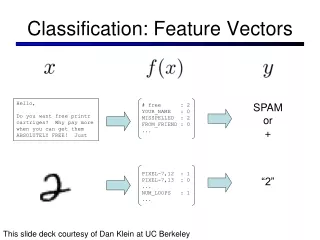
Classification: Feature Vectors Hello, Do you want free printr cartriges? Why pay more when you can get them ABSOLUTELY FREE! Just SPAM or + # free : 2 YOUR_NAME : 0 MISSPELLED : 2 FROM_FRIEND : 0 ... PIXEL-7,12 : 1 PIXEL-7,13 : 0 ... NUM_LOOPS : 1 ... “2” This slide deck courtesy of Dan Klein at UC Berkeley
Some (Simplified) Biology • Very loose inspiration: human neurons
Linear Classifiers • Inputs are feature values • Each feature has a weight • Sum is the activation • If the activation is: • Positive, output +1 • Negative, output -1 w1 f1 w2 >0? f2 w3 f3
Example: Spam • Imagine 4 features (spam is “positive” class): • free (number of occurrences of “free”) • money (occurrences of “money”) • BIAS (intercept, always has value 1) BIAS : 1 free : 1 money : 1 ... BIAS : -3 free : 4 money : 2 ... “free money”
Classification: Weights • Binary case: compare features to a weight vector • Learning: figure out the weight vector from examples # free : 4 YOUR_NAME :-1 MISSPELLED : 1 FROM_FRIEND :-3 ... # free : 2 YOUR_NAME : 0 MISSPELLED : 2 FROM_FRIEND : 0 ... # free : 0 YOUR_NAME : 1 MISSPELLED : 1 FROM_FRIEND : 1 ... Dot product positive means the positive class
Binary Decision Rule • In the space of feature vectors • Examples are points • Any weight vector is a hyperplane • One side corresponds to Y=+1 • Other corresponds to Y=-1 money 2 +1 = SPAM 1 BIAS : -3 free : 4 money : 2 ... 0 -1 = HAM 0 1 free
Mistake-Driven Classification • For Naïve Bayes: • Parameters from data statistics • Parameters: causal interpretation • Training: one pass through the data • For the perceptron: • Parameters from reactions to mistakes • Prameters: discriminative interpretation • Training: go through the data until held-out accuracy maxes out Training Data Held-Out Data Test Data
Learning: Binary Perceptron • Start with weights = 0 • For each training instance: • Classify with current weights • If correct (i.e., y=y*), no change! • If wrong: adjust the weight vector by adding or subtracting the feature vector. Subtract if y* is -1.
Multiclass Decision Rule • If we have multiple classes: • A weight vector for each class: • Score (activation) of a class y: • Prediction highest score wins Binary = multiclass where the negative class has weight zero
Example BIAS : 1 win : 1 game : 0 vote : 1 the : 1 ... “win the vote” BIAS : -2 win : 4 game : 4 vote : 0 the : 0 ... BIAS : 1 win : 2 game : 0 vote : 4 the : 0 ... BIAS : 2 win : 0 game : 2 vote : 0 the : 0 ...
Learning: Multiclass Perceptron • Start with all weights = 0 • Pick up training examples one by one • Predict with current weights • If correct, no change! • If wrong: lower score of wrong answer, raise score of right answer
Examples: Perceptron • Separable Case
Properties of Perceptrons Separable • Separability: some parameters get the training set perfectly correct • Convergence: if the training is separable, perceptron will eventually converge (binary case) • Mistake Bound: the maximum number of mistakes (binary case) related to the margin or degree of separability Non-Separable
Examples: Perceptron • Non-Separable Case
Problems with the Perceptron • Noise: if the data isn’t separable, weights might thrash • Averaging weight vectors over time can help (averaged perceptron) • Mediocre generalization: finds a “barely” separating solution • Overtraining: test / held-out accuracy usually rises, then falls • Overtraining is a kind of overfitting
Fixing the Perceptron • Idea: adjust the weight update to mitigate these effects • MIRA*: choose an update size that fixes the current mistake… • … but, minimizes the change to w • The +1 helps to generalize * Margin Infused Relaxed Algorithm