Understanding the Role of the Working Class in Political Economy
100 likes | 212 Vues
This overview delves into the significance of the working class within International Political Economy (IPE). It explores why the working class matters amidst changing global political dynamics and their marginalization from both right and left. The text addresses the contested nature of workplace politics, the experiences of workers within and against capitalism, and the formation of political identity amidst economic structures. By examining workplace grievances and the history of working-class struggle, it highlights the power of collective action and the importance of subjective needs in shaping political interests.


Understanding the Role of the Working Class in Political Economy
E N D
Presentation Transcript
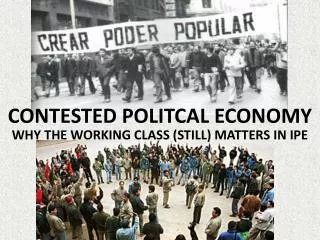
CONTESTED POLITCAL ECONOMY WHY THE WORKING CLASS (STILL) MATTERS IN IPE
Overview • Why does the working class matter? • Workers within and against capitalism • The contested politics of workplace • A political economy of the working class
Changes in the global political economy and marginalisation from right and left • Understanding diverse outcome and progressive change • The ‘how’ question and why it matters • Conflicts in the workplace, interest formation and political influence
Economic determinism, structure and objectification in capitalism • The problem of ‘labour’ as abstract category and political actor • Subjective determinations of workers and political identity • Individualisation and the problem of atomisation
Opening the ‘black box’ of production • Relations of and in production • The meaning and interpretation of workplace grievances • The contested politics of the workplace and working class formation
The objectification of labour and the power of social productivity • From subjective needs to political interests • Working class struggle and the formation of the working class acting ‘for self’ • Historical specificity rooted in the collective experience of work
![Origins of Islamic Civilization [contested term]](https://cdn0.slideserve.com/741662/origins-of-islamic-civilization-contested-term-dt.jpg)
![Origins of Islamic Civilization [contested term]](https://cdn0.slideserve.com/1253716/origins-of-islamic-civilization-contested-term-dt.jpg)