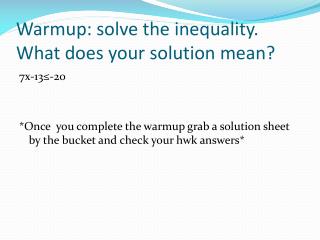
Warmup : solve the inequality. What does your solution mean?
80 likes | 198 Vues
This lesson covers solving inequalities, specifically focusing on the inequality (7x - 13 leq -20). By completing the warmup, students gain foundational skills before diving into Triangle Inequalities. We explore Theorems 5-10, 5-11, and 5-12, highlighting relationships between angles and sides in triangles. Learn how to determine side lengths in relation to angles and apply the Triangle Inequality Theorem. Relevant examples and practice exercises will solidify these concepts for better comprehension.


Warmup : solve the inequality. What does your solution mean?
E N D
Presentation Transcript
Warmup: solve the inequality. What does your solution mean? 7x-13≤-20 *Once you complete the warmup grab a solution sheet by the bucket and check your hwk answers*
Section 5.5: Inequalities in Triangles LEQ: How can use angle measures or side lengths to make conclusions in triangles?
Theorem 5-10 • If two sides of a triangle are not congruent, then the larger angle lies opposite the longer side. Theorem 5-11: If two angles of a triangle are not congruent, then the longer side lies opposite the larger angle.
Ex: List the sides of the angles from longest to shortest K N H 40 30 70 60 90 110 G I J L M O
List the angles from smallest to largest Q T 12 U 13 8 16 24 S R P 11
Thm. 5-12 • Triangle Inequality Thm.: The sum of the lengths of any two sides of a triangle is greater than the length of the third side. • Aka: the sum of the lengths of the two smallest sides is >the length of the third. A,b,c where a>b>c ex. 9,7,6 A+c>b a+b>c, so
If 2 sides are 5 and 12, what is the range for the 3rd side? 12-5<x<12+5 Why? • 5+x>12 if x is not biggest side • 12+5>x if x is biggest side
Hwk: p. 292-293 • 4-27 odds, 35-37