Download
1 / 11
110 likes | 219 Vues
Hosted by NCAR and Colorado State University from May 20-31, 2002, this conference focused on integrating models and data for biogeochemical research, emphasizing the challenges in determining regional CO2 fluxes. As the need for regional constraints grows, an integrated approach using data assimilation and network design becomes critical for understanding the carbon cycle. The conference gathered experts to discuss the importance of data collection and modeling in addressing uncertainties in carbon emissions and enhancing understanding of continental-scale fluxes.

E N D
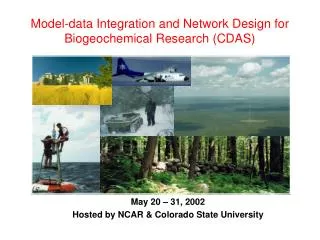
May 20 – 31, 2002 Hosted by NCAR & Colorado State University Model-data Integration and Network Design for Biogeochemical Research (CDAS)
Overriding Themes in Carbon Cycle Research • Motivations for constraints on regional (~1000 km) scales are many and growing • Challenges to determining regional CO2 fluxes involve both data and modeling • Integrated approach needed to move forward - data assimilation, network design
TEMPERATURE (C) (IPCC, 2001) (NRCS/USDA, 1997) Regional scale is critical for linking to underlying processes (NRCS/USDA, 1997) CHLOROPHYLL (SeaWIFS, 2002)
Relevant U.S. Planning Documents(Current U.S. carbon cycle expenditures $40-50M/yr) CCSP, 1999: +$135-300M 2000-2005 $200-250M/yr 2005- NACP, 2002: +$40-70M/yr 2002-2005 +$50-100M/yr 2005- LSCOP, 2002: $250M 2002-2006 $150M 2007-2011
(from The Emerging International Greenhouse Gas Market, Pew Center on Global Climate Change, 2002) At $2 per ton CO2e: 0.1 GtC (~1/10 of current uncertainty on U.S. uptake and ~1/4 of current U.S. emissions above Kyoto obligation) would trade at approximately. . . $700,000,000.00
Continental Signal Versus Noise Using Current Inverse Methodologies (TransCom, 2002)
Unresolved variance presently contains most of the information on continental-scale fluxes
Many network design studies1 have been conducted, with similar results: • Need more data • continental, (South America, Africa, Siberia) • Southern Ocean • airborne 1e.g. Rayner et al., 1996; Gloor et al., 1999; LSCOP, 2002; Patra, subm. 2001; Suntharalingam, subm. 2002
CDAS Approach • Bring together observationalists and modelers to form an integrated approach to improving our understanding of the global carbon cycle. • Initial effort: Network design exercises based on a selected assimilation modeling strategy. • Ongoing: Further development of the assimilation tool and support for testing and planning/educational use by the community.
Technical Team • Roger Dargaville (CGD) • David Baker (ASP) • Steve Aulenbach (CGD) • Jennifer Oxelson (ESIG/ATD) • Kathy Fisher (CGD) • Dave Brown (SCD) • Mark Moore (SGD)