Download
1 / 3
30 likes | 127 Vues
Explore the relationship between QTc interval prolongation and arrhythmia risk associated with drugs, including exponential increases in risk with QTc values exceeding 440msec, along with factors impacting QTc signaling and potential drug interactions.

E N D
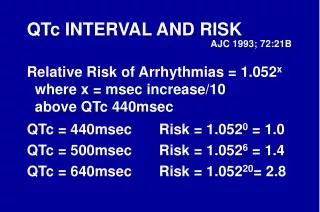
QTc INTERVAL AND RISKAJC 1993; 72:21B • Relative Risk of Arrhythmias = 1.052x • where x = msec increase/10 • above QTc 440msec • QTc = 440msec Risk = 1.0520 = 1.0 • QTc = 500msec Risk = 1.0526 = 1.4 • QTc = 640msec Risk = 1.05220= 2.8
DRUGS AND QTc: ISSUES • 1. QTc prolongation and risk: exponential • 2. Magnitude of the QTc signal: • mean QTc; range & outliers • 3. Drug effect on QTc: • a. direct: e.g., sotalol, cisapride • b. indirect (interaction): • i) drug-drug: terfenadine + ketoconazole • ii) drug-gene: LQTS mutation/polymorphism
DRUGS AND QTc: Questions • 1. Do the pre-clinical studies indicate an effect on ventricular repolarization? • 2. Do clinical studies indicate a QTc signal? • 3. What is the magnitude of the QTc signal? • 4. Are there potential drug interactions? • 5. Does the drug have unique characteristics?