Understanding Key Concepts of Motion: Definitions and Applications
This comprehensive guide outlines essential physics definitions related to motion, including displacement, distance, speed, and velocity. It delves into the concept of acceleration, explaining how it occurs when an object's speed or direction changes. The guide also defines average acceleration as the change in velocity over time and discusses the implications of positive and negative acceleration. Moreover, it includes details on uniform acceleration and equations governing falling bodies under the effect of gravity, specifically highlighting the acceleration due to gravity at 9.80 m/s².

Understanding Key Concepts of Motion: Definitions and Applications
E N D
Presentation Transcript
Review Basic Definitions – you should know these. In your own words, write a definition for each Position: Displacement: Distance: Speed: Velocity: Text Pages 42 – 43 Uniform Acceleration
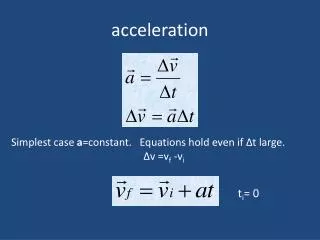
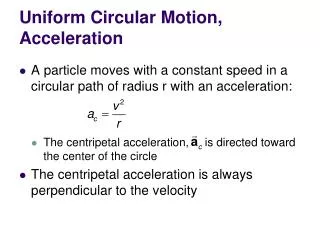
Acceleration • Definition • A body accelerates when it changes speed or direction or both. Average acceleration • is defined as the change in velocity divided by the time elapsed during the change in • velocity • Positive and Negative Acceleration • Text Page 44
Uniform Acceleration • Four Equations for Uniform Acceleration
Falling Bodies • Acceleration Due to Gravity – Free Fall • 9.80 m/s2 Using the diagram to your right, you need to be able to: 1. explain why acceleration is uniform 2. describe why velocity changes 3. graph the motion of the ball in a velocity time graph Text pages 50 - 51