Understanding Body Composition and the Impact of Fat Distribution on Health
This overview explores body composition, specifically the proportions of fat and fat-free mass in individuals. It highlights the importance of differentiating between essential and non-essential fat, as well as the significance of body weight classifications such as overweight and obesity. The prevalence of these conditions among Americans is discussed, along with ways to measure body fat percentage and the associated health risks. Lastly, it examines fat distribution patterns—android and gynoid—and their implications for cardiovascular disease and diabetes.

Understanding Body Composition and the Impact of Fat Distribution on Health
E N D
Presentation Transcript
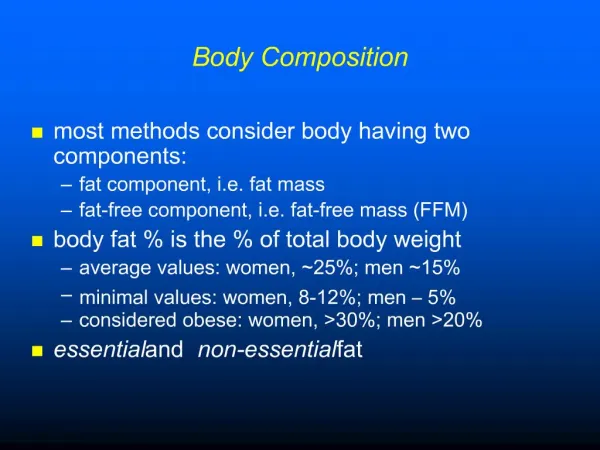
Body Composition The body’s proportion of fat and fat-free mass
Fat Free Mass • All non-fat tissue
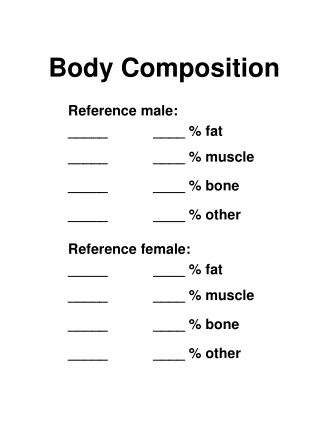
Fat (adipose tissue) • Essential Fat – normal body functioning Males: __% to __% Females: __% to __ % • Non-Essential Fat – storage of fat in _______ tissue. • _______________________________ • _______________________________ • _______________________________ • _______________________________
Overweight • Body weight above recommended range for good health. • 10% above recommended range (Ht/Wt) • BMI 25 – 29.9 • ___% of adult Americans are overweight
Obesity • A more serious degree of overweight causing a significant impairment of health. • 20% above recommended weight (Ht/Wt) • BMI >30 • ___% of American adults are obese
Percent Body Fat • The proportion of the body’s total weight that is fat. • Methods of determining % body fat • Underwater weighing • Skinfold (calipers) • Bio-impedance (ELG) • Bod Pod
Percent Body Fat Chart Males (% Fat) Females (% Fat) Rating (ages 18-30) (ages 18-30) Desirable 6-14 10-19 Acceptable 15-17 20-24 Overfat 18-19 25-29 Obese 20 or over 30 or over
Body Fat Distribution – Android (apple shaped) • Predominantly ____ • Region – _________ • Site – __________ • Fat cell size – _____ • Fat mobilization - ___________
Android Distribution & Disease Android = Increased risk for cardiovascular disease and diabetes. • Easy fat mobilization = sensitive to ________ resulting in increased lipids in blood = LDL • Large fat cell size = less ____________ produced so less sensitive to insulin Android fat distribution is determined by: • W/H Ratio: Male >.94 Female >.82 • Waist Cir.: Male >40” Female >35”
Body Fat Distribution – Gynoid (Pear shaped) • Predominantly ________ • Region - _________ ____________ • Site – ___________ • Fat cell size – _____ • Fat mobilization - ___________